DocuCare: Empowering School Nurses through Better Documentation
DocuCare: Empowering School Nurses through Better Documentation
Project Type
Project Type
Web, B2B, 0-1, SaaS-like (accounts, centralized data, administrative features)
Web, B2B, 0-1, SaaS-like (accounts, centralized data, admin features)
Web, B2B, 0-1, SaaS-like (accounts, centralized data, admin features)
Team
Team
3 Product Designers (including myself)
3 Product Designers (including myself)
Timeline
Timeline
20 weeks, Agile Sprints, Hybrid
20 weeks, Agile Sprints, Hybrid
Tools
Tools
Figma, Miro, Zoom
Figma, Miro, Zoom
Client
Client
University of Washington School of Nursing
University of Washington School of Nursing
Overview
Overview
DocuCare is a centralized web-based documentation tool designed to streamline school nurses’ daily workflows and quantify their contributions. By addressing outdated and fragmented systems, the tool reduced documentation time by up to 40% and helped elevate the visibility of nurses' essential work.
DocuCare is a centralized web-based documentation tool designed to streamline school nurses’ daily workflows and quantify their contributions. By addressing outdated and fragmented systems, the tool reduced documentation time by up to 40% and helped elevate the visibility of nurses' essential work.
My Role
My Role
I led UX research and co-designed the platform, guiding the end-to-end process from interviews and surveys to prototyping and usability testing. My work translated insights from 540+ nurses into intuitive, nurse-centered features that achieved a 100% task success rate and enabled secure, efficient documentation.
I led UX research and co-designed the platform, guiding the end-to-end process from interviews and surveys to prototyping and usability testing. My work translated insights from 540+ nurses into intuitive, nurse-centered features that achieved a 100% task success rate and enabled secure, efficient documentation.
IMPACT
IMPACT
Reached through research to validate key needs
Reached through research to validate key needs
540+ nurses
540+ nurses
540+ nurses
Achieved in moderated usability testing with school nurses
in moderated usability testing with school nurses
100% task success rate
100% task success rate
100% task success rate
projected with prototype
projected with prototype
35-40% reduction in documentation time
35-40% reduction in documentation time
35-40% reduction in documentation time
We conducted 6 interviews, a survey (540+ school nurses) to uncover their real pain points and workflows.
We conducted 6 interviews, a survey (540+ school nurses) to uncover their real pain points and workflows.
We conducted 6 interviews, a survey (540+ school nurses) to uncover their real pain points and workflows.
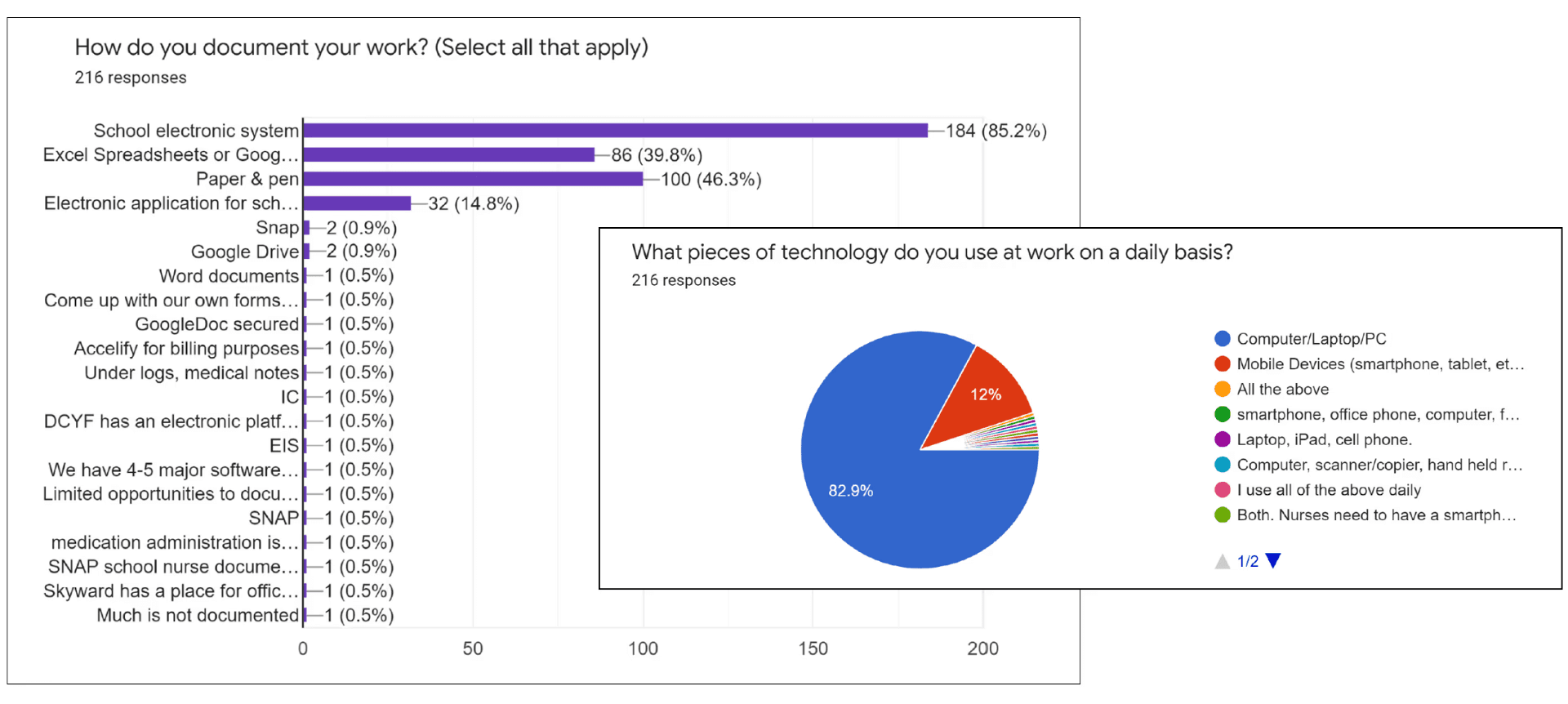
I led a two-phase research process combining 5 in-depth interviews and a wide-reaching survey (540 responses) to understand current documentation methods, time pressures, and system frustrations. Key findings included:
I led a two-phase research process combining 5 in-depth interviews and a wide-reaching survey (540 responses) to understand current documentation methods, time pressures, and system frustrations. Key findings included:
85% used a proprietary system, but nearly half still relied on pen and paper.
1
Most documentation tools lacked standardization, clarity, and user control.
2
Nurses desired fast, structured, and secure methods for logging both medical and admin tasks, primarily from desktop/PCs.
3
85% used a proprietary system, but nearly half still relied on pen and paper.
85% used a proprietary system, but nearly half still relied on pen and paper.
1
Most documentation tools lacked standardization, clarity, and user control.
Most documentation tools lacked standardization, clarity, and user control.
2
Nurses desired fast, structured, and secure methods for logging both medical and admin tasks, primarily from desktop/PCs.
Nurses desired fast, structured, and secure methods for logging both medical and admin tasks, primarily from desktop/PCs.
3
3
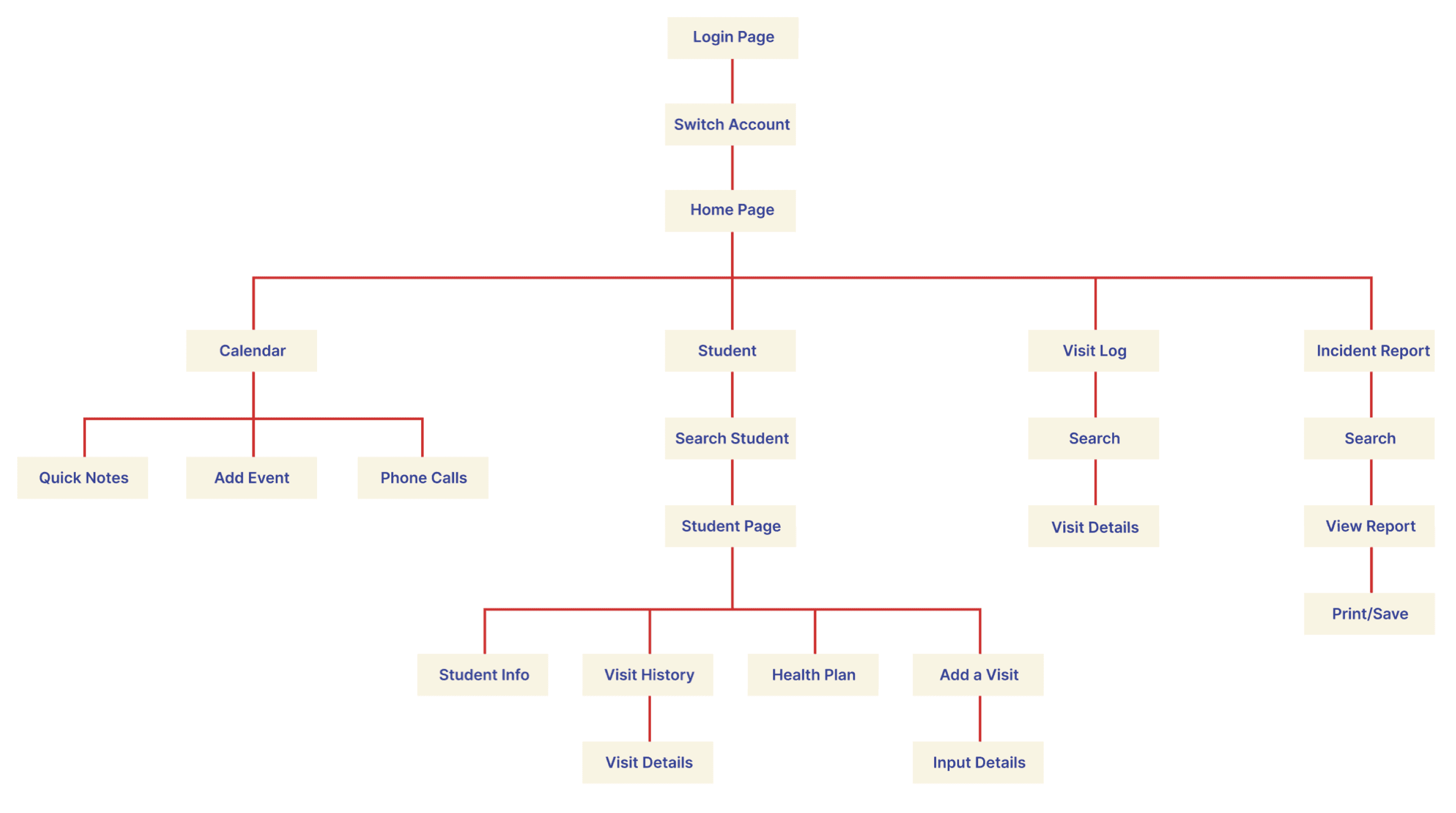
I translated research into themes and design principles to address documentation inefficiencies head-on.
I translated research into themes and design principles to address documentation inefficiencies head-on.
I translated research into themes and design principles to address documentation inefficiencies head-on.
Using affinity mapping and thematic coding, we extracted design opportunities around efficiency, security, and nurse-centered UX. These elements shaped our information architecture and inspired low-fidelity wireframes.
Using affinity mapping and thematic coding, we extracted design opportunities around efficiency, security, and nurse-centered UX. These elements shaped our information architecture and inspired low-fidelity wireframes.
Using affinity mapping and thematic coding, we extracted design opportunities around efficiency, security, and nurse-centered UX. These elements shaped our information architecture and inspired low-fidelity wireframes.
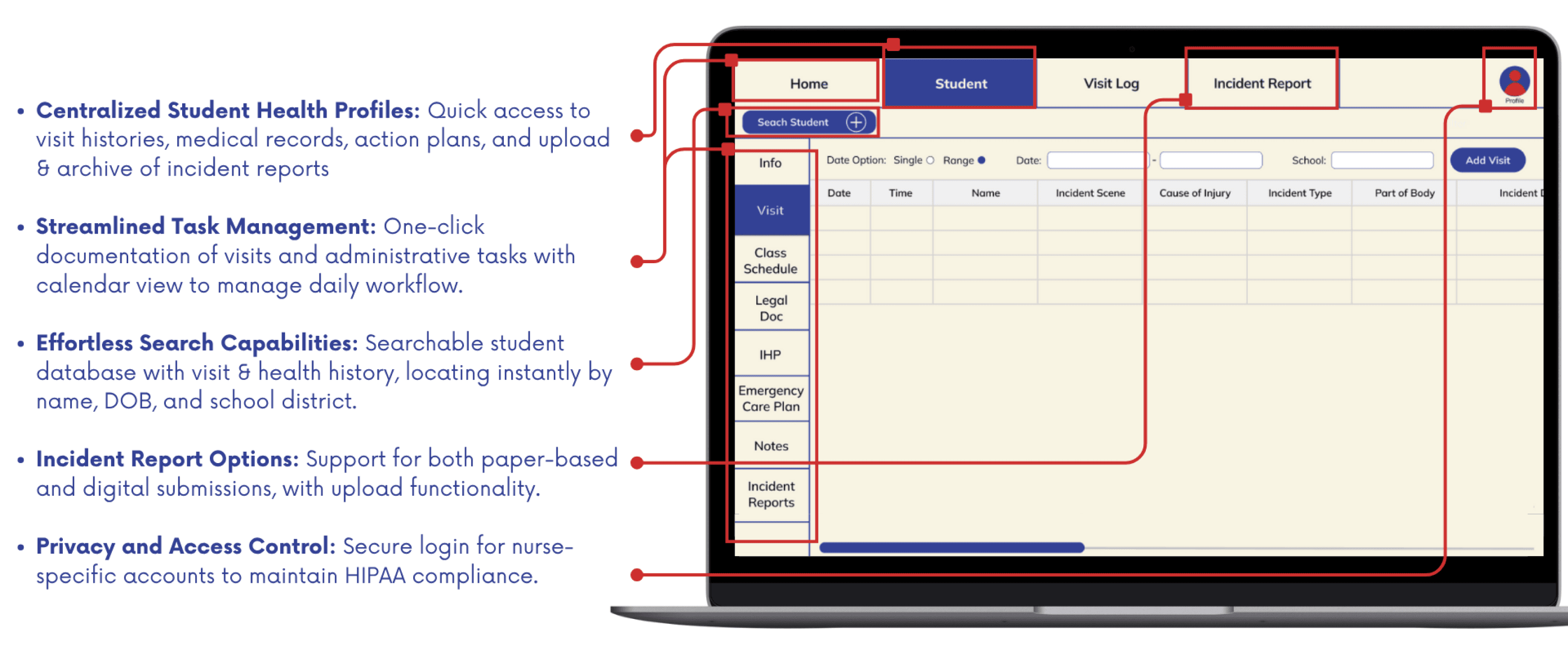
I proposed key features and sketched flows for:
• A secure login page with user-specific access
• Student-centric dashboards for quick visit logging
• Admin task tracking (emails, calls, meetings)
• Search-first navigation for quick retrieval
• A visit log for all student interactions
I proposed key features and sketched flows for:
-A secure login page with user-specific access
-Student-centric dashboards for quick visit logging
-Admin task tracking (emails, calls, meetings)
-Search-first navigation for quick retrieval
-A visit log for all student interactions
I proposed key features and sketched flows for:
-A secure login page with user-specific access
-Student-centric dashboards for quick visit logging
-Admin task tracking (emails, calls, meetings)
-Search-first navigation for quick retrieval
-A visit log for all student interactions
Key Design Concepts:
Key Design Concepts:
Key Design Concepts:
01
01
01
Encourages schedule organization and time management
Encourages schedule organization and time management
Encourages schedule organization & time management
Healthcare workers can make appointments, document their daily tasks, and plan out their daily schedules from the Home page.
Healthcare workers can make appointments, document daily tasks, and plan out daily schedules from the Home page.
02
02
02
Promotes student at center for documentation
Promotes student at center for documentation
Promotes student at center for documentation
Information on students is put at the forefront of the UI. Nurses can easily parse key information from the Incident Report page or find more details about their patient in the Student page.
Information on students is put at the forefront of the UI. Nurses easily parse through key information from the Incident Report page & find more details about their patient in the Student page.
03
03
03
Fosters access to previous documentation
Fosters access to previous documentation
Fosters access to previous documentation
With the help of a daily and monthly view of their calendar, nurses can look back at their past tasks. Additionally, nurses can have a view in each school district to find more details about each patient and visit.
With the daily and monthly view of their calendar, nurses can look back at their past tasks. Nurses can also view each school district to find more details about each patient/visit.
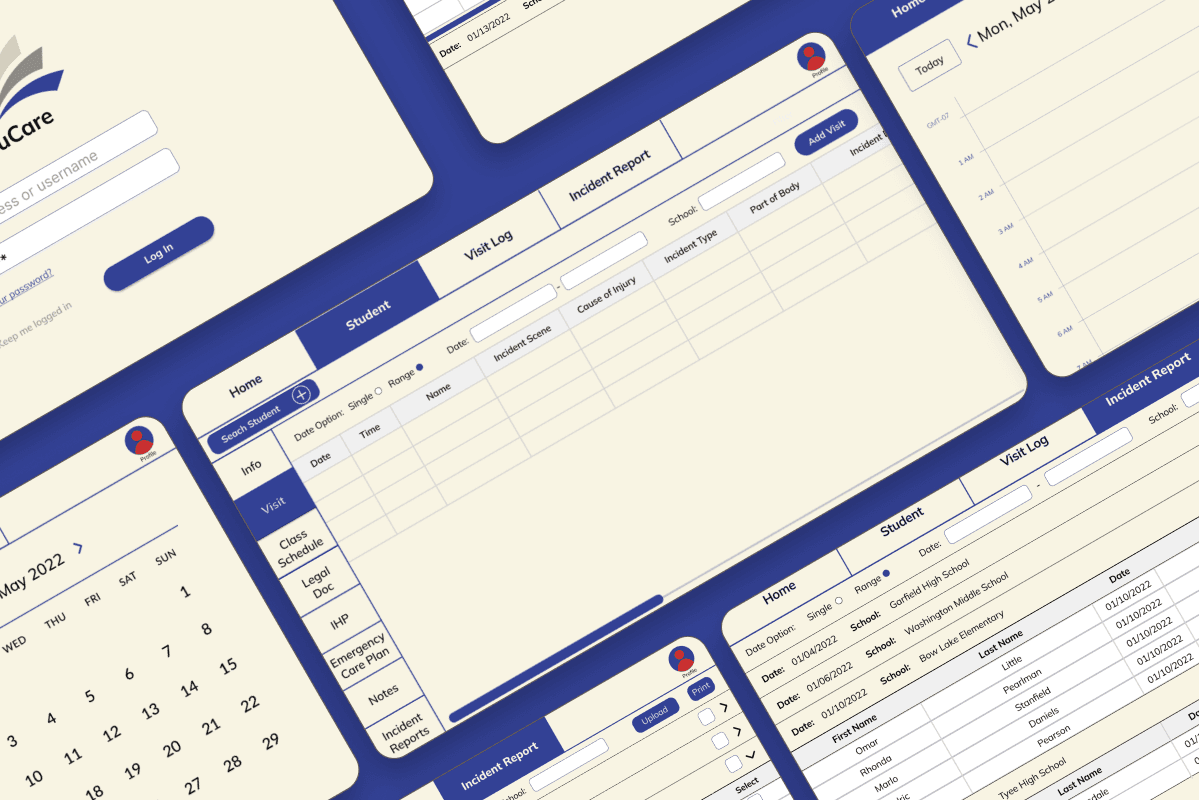
I co-designed and iterated a responsive web app that gives nurses fast, flexible ways to document and retrieve data.
I co-designed and iterated a responsive web app that gives nurses fast, flexible ways to document and retrieve data.
I co-designed and iterated a responsive web app that gives nurses fast, flexible ways to document and retrieve data.
Desktop became the primary platform since 83% of nurses used PCs at work. I co-designed five core screens in Figma: Login, Home (calendar-based), Student View, Visit Log, and Incident Report. The interface prioritized:
Desktop became the primary platform since 83% of nurses used PCs at work. I co-designed five core screens in Figma: Login, Home (calendar-based), Student View, Visit Log, and Incident Report. The interface prioritized:
Quick-entry forms and default fields
Quick-entry forms and default fields
Speed & Simplicity
Speed & Simplicity
Menu options for clarity + optional notes for detail
Menu options for clarity + optional notes for detail
Structure
Structure
Individual login and editable permissions
Individual login and editable permissions
Security
Security
Search and filters to access visit history easily
Search and filters to access visit history easily
Continuity
Continuity
User testing with nurses surfaced clarity issues and new needs, which we addressed through strategic design changes.
User testing with nurses surfaced clarity issues and new needs, which we addressed through strategic design changes.
User testing with nurses surfaced clarity issues and new needs, which we addressed through strategic design changes.
I conducted moderated Zoom sessions with two Albany district nurses who had participated in our initial research. We gave them tasks based on real-world scenarios and collected usability feedback.
I conducted moderated Zoom sessions with two Albany district nurses who had participated in our initial research. We gave them tasks based on real-world scenarios and collected usability feedback.
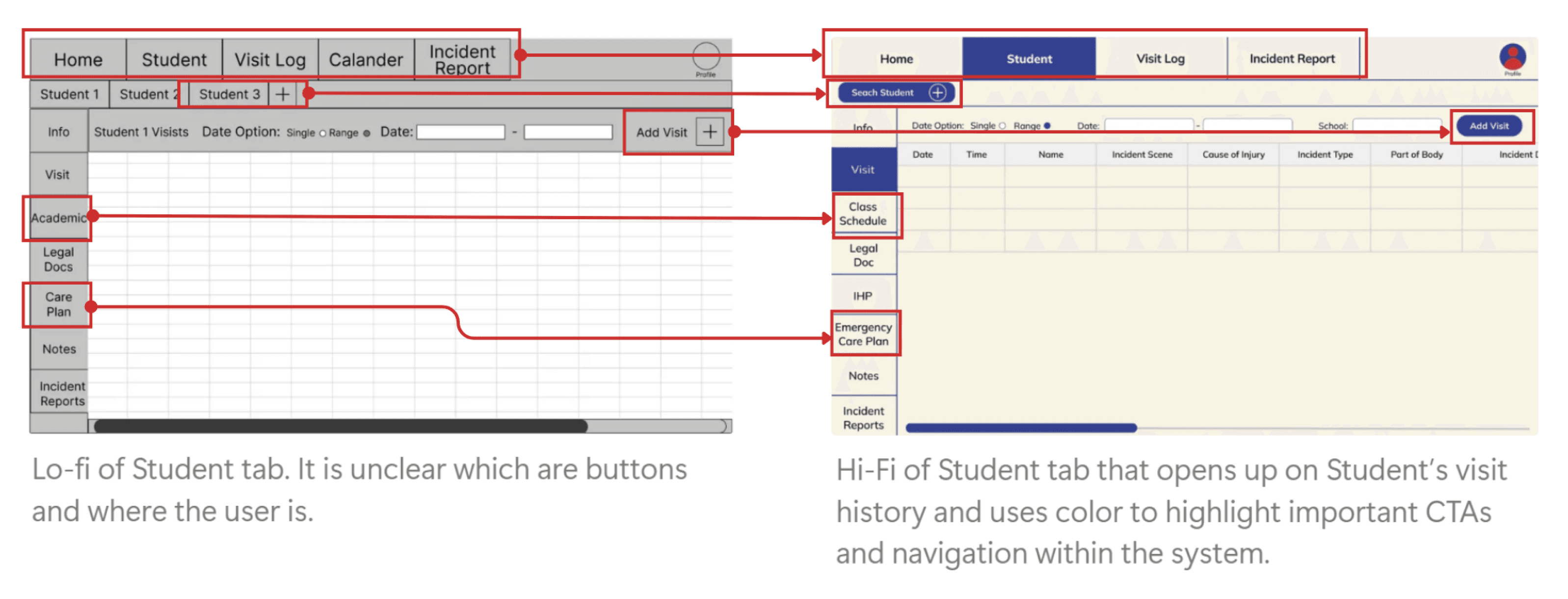
Challenge #1 - Confusing Navigation
Challenge #1 - Confusing Navigation
Challenge #1 - Confusing Navigation
Users were unclear whether to access visit history from the "Student" or "Visit Log" tab.
Users were unclear whether to access visit history from the "Student" or "Visit Log" tab.
Users were unclear whether to access visit history from the "Student" or "Visit Log" tab.
Solution: Added onboarding walkthrough and revised navigation language.
Solution: Added onboarding walkthrough and revised navigation language.
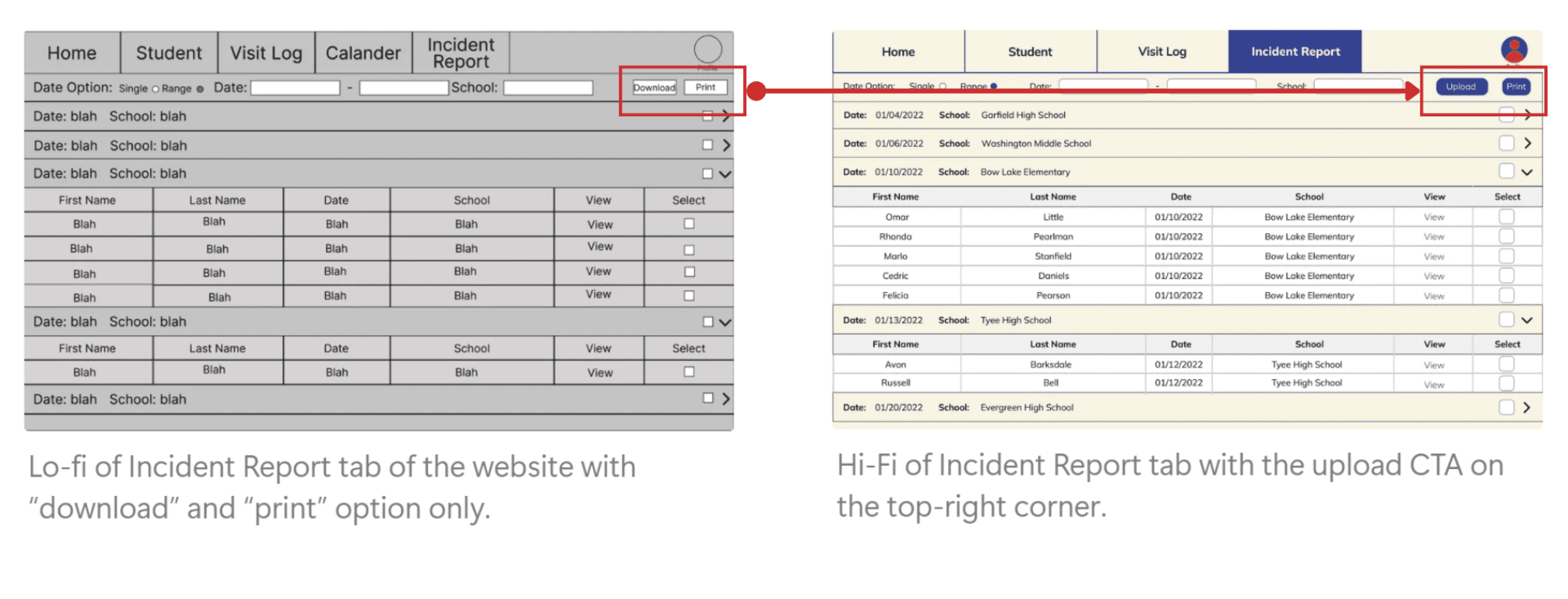
Challenge #2 - Need for paper + digital flexibility in incident reports
Challenge #2 - Need for paper + digital flexibility in incident reports
Challenge #2 - Need for paper + digital flexibility in incident reports
Some staff preferred paper, others digital. They all want it stored digitally.
Some staff preferred paper, others digital. They all want it stored digitally.
Some staff preferred paper, others digital. They all want it stored digitally.
Solution: Added upload functionality so scanned reports could live in the system + print function
Solution: Added upload functionality so scanned reports could live in the system + print function
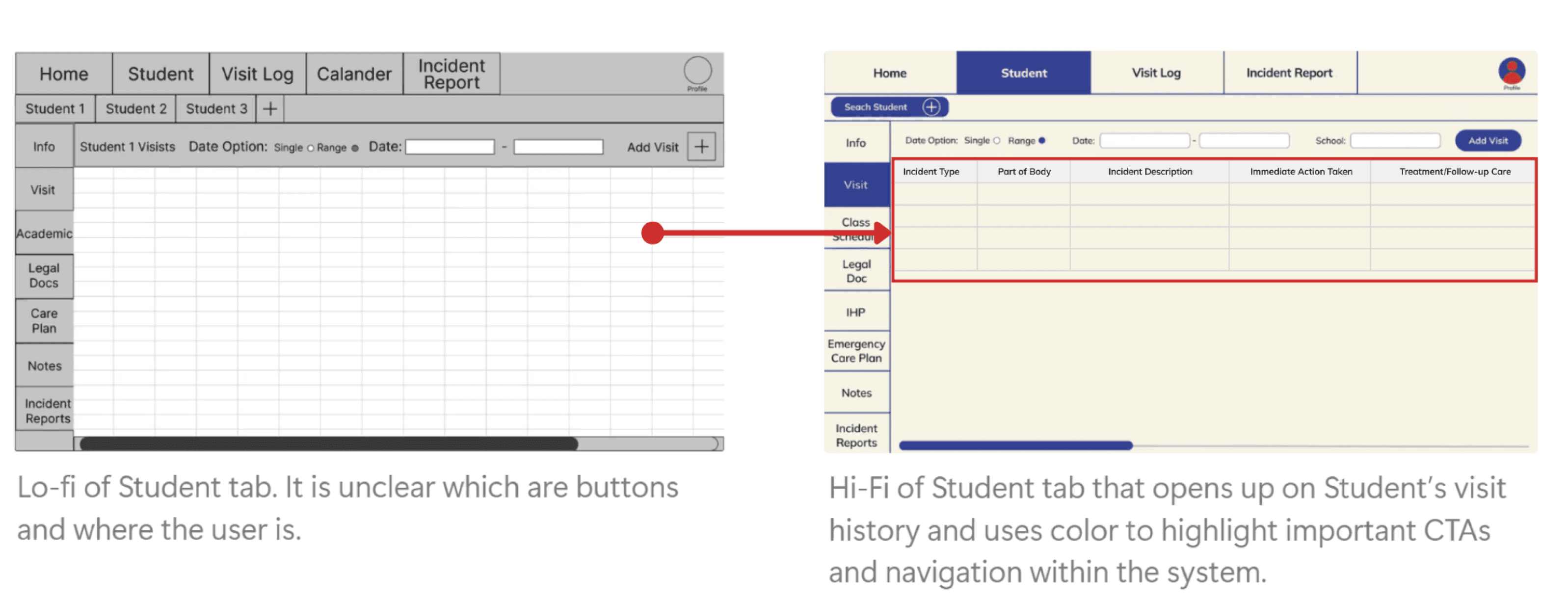
Challenge #3 - Lack of Contact Tracking
Challenge #3 - Lack of Contact Tracking
Challenge #3 - Lack of Contact Tracking
Users wanted to document a follow-up and touchpoints with a given patient.
Users wanted to document a follow-up and touchpoints with a given patient.
Users wanted to document a follow-up and touchpoints with a given patient.
Solution: Added a structured visit form that allowed treatment touchpoints and follow-ups integrated directly into the student profile.
Solution: Added a structured visit form that allowed treatment touchpoints and follow-ups integrated directly into the student profile.
The final prototype offered a secure, intuitive hub for nurse documentation, earning praise from both users and stakeholders.
The final prototype offered a secure, intuitive hub for nurse documentation, earning praise from both users and stakeholders.
The final prototype offered a secure, intuitive hub for nurse documentation, earning praise from both users and stakeholders.
The result was a high-fidelity prototype that streamlined nurse documentation into five intuitive flows. The prototype successfully addressed all three pillars of our design concepts: efficiency, student-centric, and ease of use and access. Sponsors and testers highlighted:
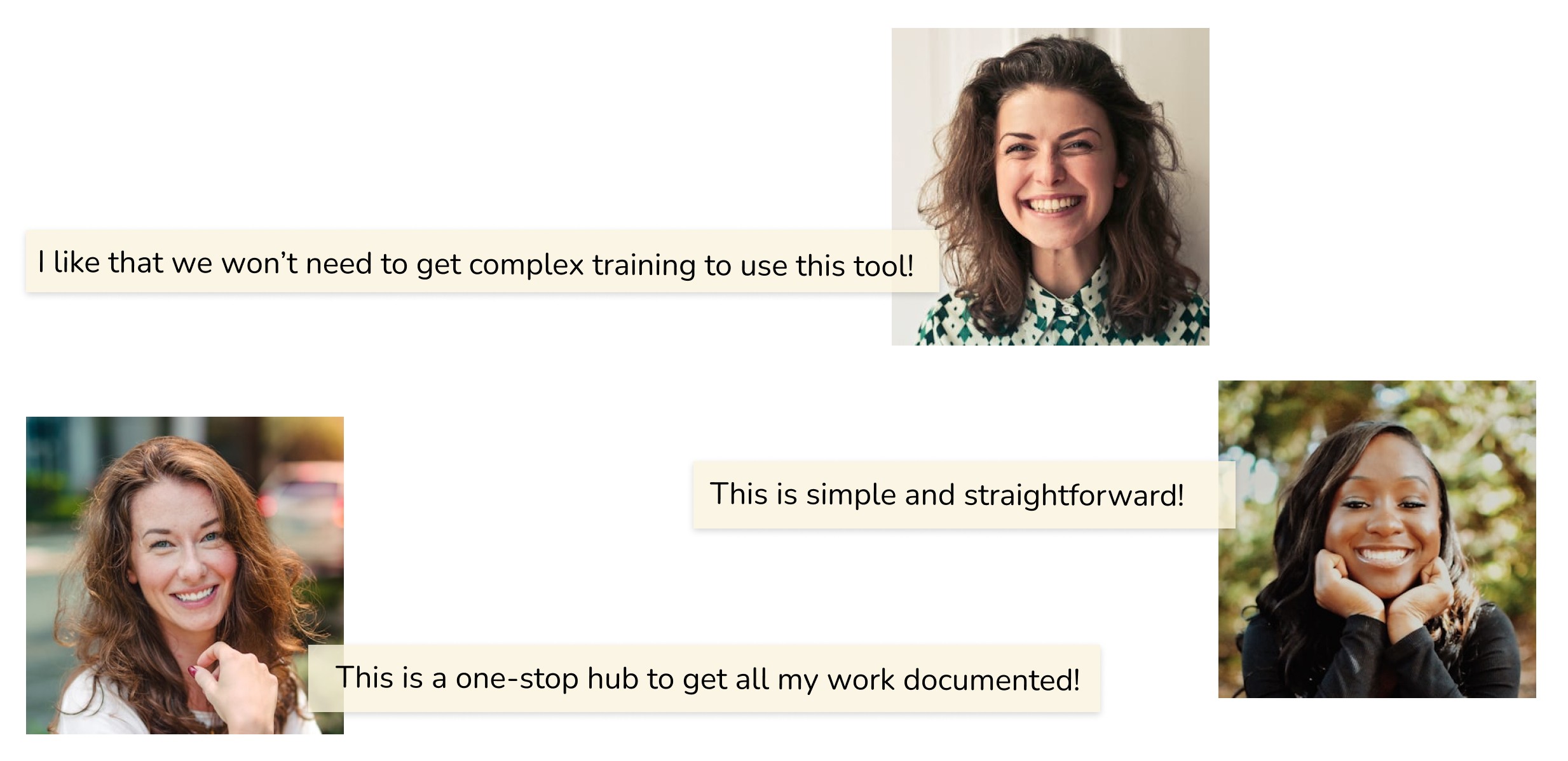
No training required to use the system
No training required to use the system
1
1
Felt seen and supported by the design
Felt seen and supported by the design
2
2
Could finally quantify their non-patient care tasks
Could finally quantify their non-patient care tasks
3
3
This project sharpened my leadership in UX research and design. It reinforced the value of stakeholder collaboration in complex problem spaces.
This project sharpened my leadership in UX research and design. It reinforced the value of stakeholder collaboration in complex problem spaces.
This project sharpened my leadership in UX research and design. It reinforced the value of stakeholder collaboration in complex problem spaces.
This was my first time leading a full-cycle UX research effort across interviews, surveys, synthesis, and testing, as well as co-leading the UX design process.
This was my first time leading a full-cycle UX research effort across interviews, surveys, synthesis, and testing, as well as co-leading the UX design process.
If given more time, I’d expand testing to nurses from different districts and refine the workflows. Nonetheless, this project strengthened my confidence in designing for public-sector/healthcare tools that have a measurable social impact.
If given more time, I’d expand testing to nurses from different districts and refine the workflows. Nonetheless, this project strengthened my confidence in designing for public-sector/healthcare tools that have a measurable social impact.
If given more time, I’d expand testing to nurses from different districts and refine the workflows. Nonetheless, this project strengthened my confidence in designing for public-sector/healthcare tools that have a measurable social impact.
I learned to:
I learned to:
Translate qualitative insights into actionable product decisions
Translate qualitative insights into actionable product decisions
Design for users under time pressure and systemic constraints
Design for users under time pressure and systemic constraints
Navigate feedback from healthcare professionals and sponsors to align business goals with real user needs
Navigate feedback from healthcare professionals and sponsors to align business goals with real user needs
Navigate feedback from healthcare professionals and sponsors to align business goals with real user needs
Feedback from Nurses
Creating a Brand That Communicates Care and Clarity
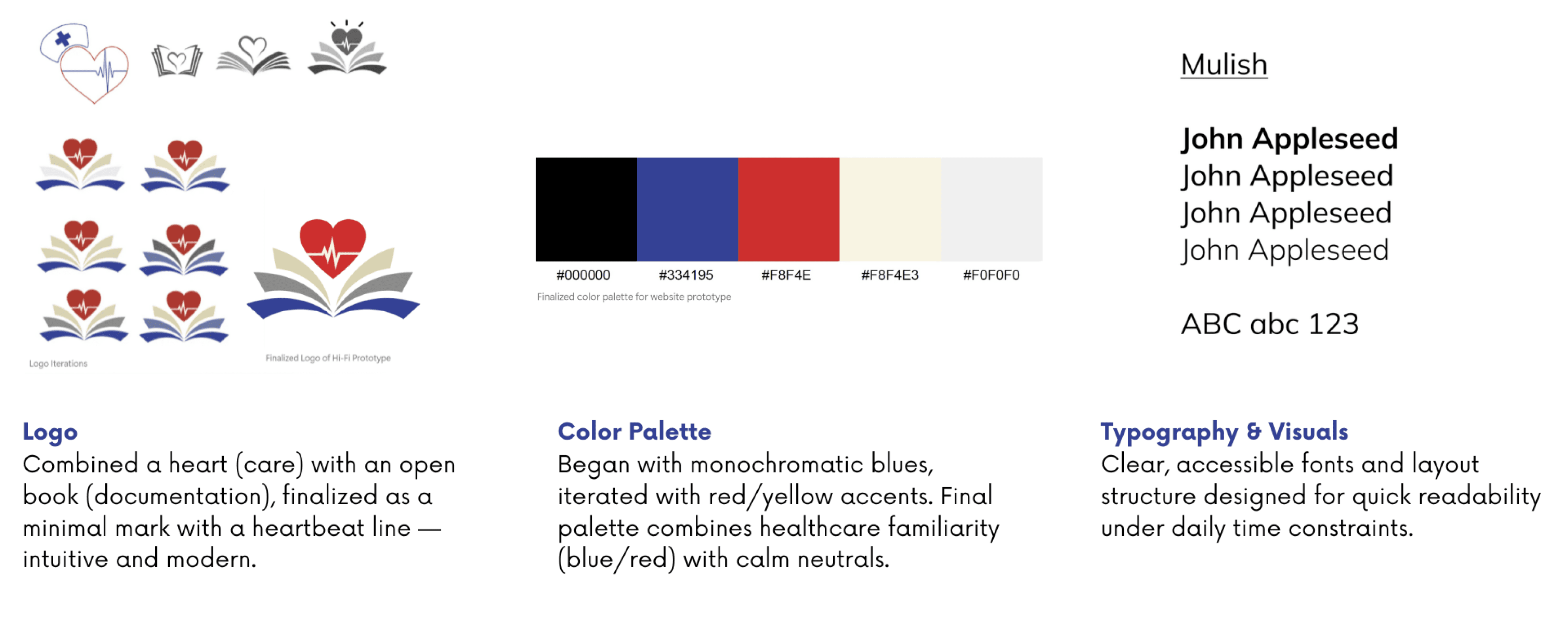
Creating a Brand That Communicates Care and Clarity
Creating a Brand That Communicates Care and Clarity
Designed a visual identity that resonates with school nurses — familiar, trustworthy, and reflective of their work's heart and precision.
Designed a visual identity that resonates with school nurses — familiar, trustworthy, and reflective of their work's heart and precision.
NEXT
NEXT
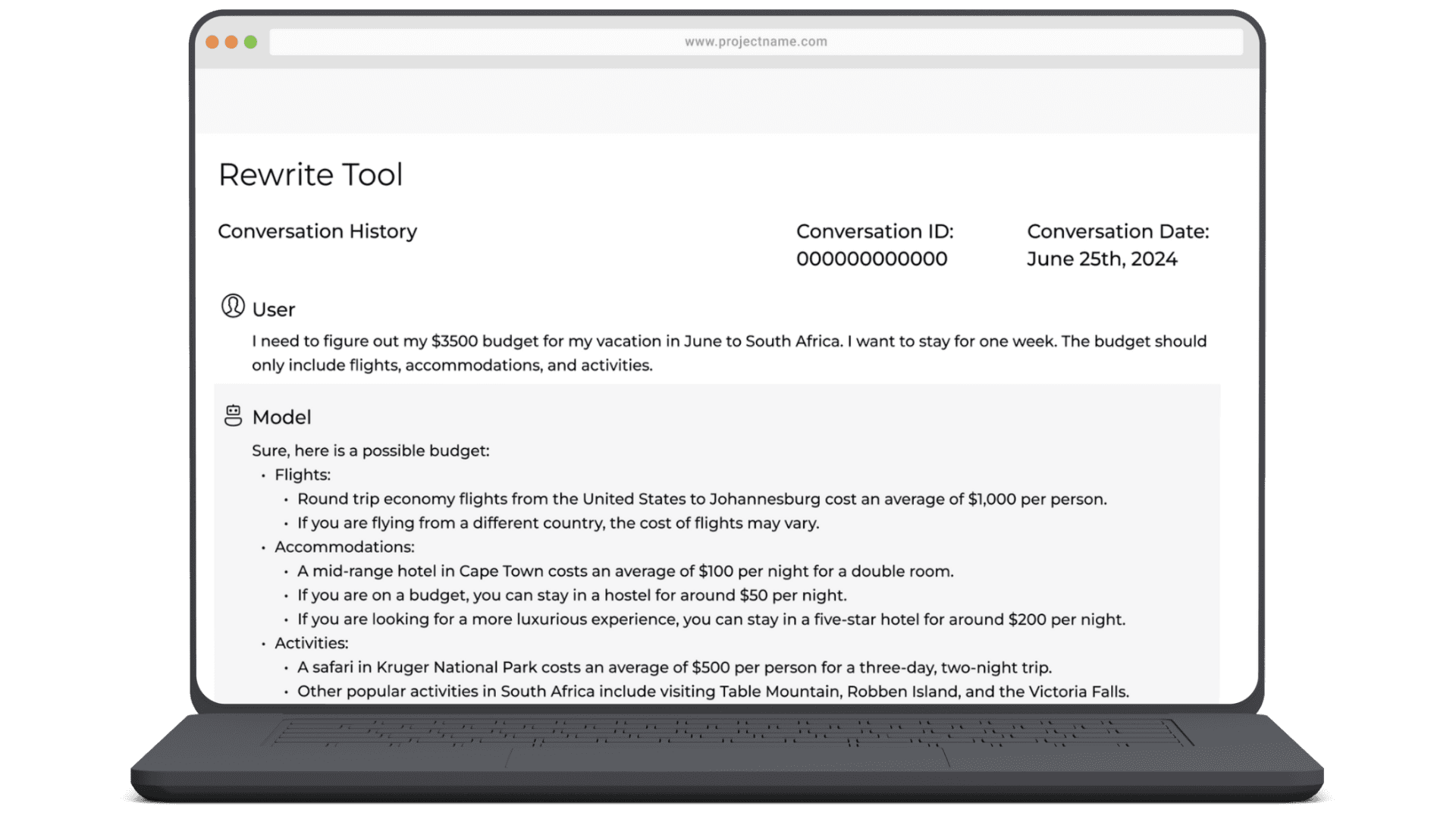
Gen AI LMM Training: Designing Safer, Smarter AI Interactions
Training a Large Language Model with Human-Centered, High-Quality Prompts
Read Case Study
DocuCare: Empowering School Nurses through Better Documentation
A tracking tool born from the vision to not only facilitate but also illuminate the critical work of school nurses.
Read Case Study
DocuCare: Empowering School Nurses through Better Documentation
A tracking tool born from the vision to not only facilitate but also illuminate the critical work of school nurses.
Read Case Study
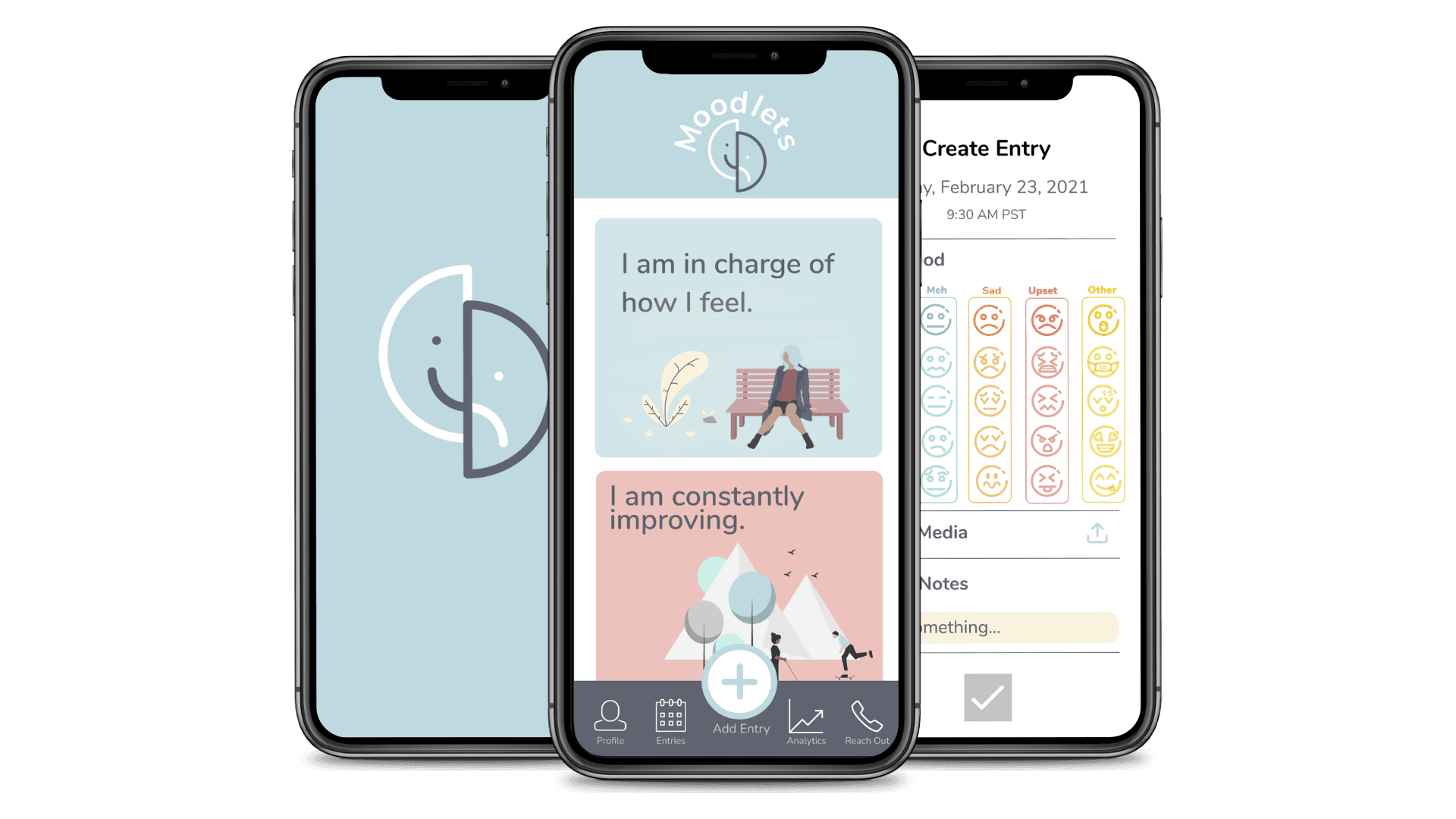
Moodlets: Mobile App that Shows Emotional Patterns & Connects Mental Health Support
A highly functional tool that brings a new level of insight into personal emotional trends and facilitates connections with health professionals.
Read Case Study
Gen AI LMM Training: Designing Safer, Smarter AI Interactions
Training a Large Language Model with Human-Centered, High-Quality Prompts
Read Case Study
Read Case Study
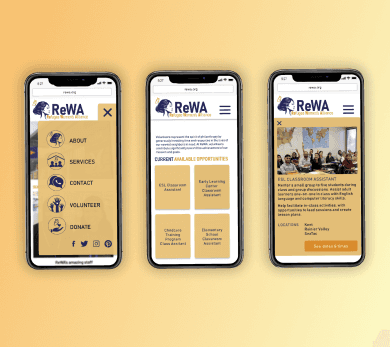
ReWA: A Visual Strategy to Promote Family & Community Empowerment
A modern, cohesive, and impactful visual identity that authentically reflects the mission of Refugee Women's Alliance—supporting refugee and immigrant women and their families.
Read Case Study
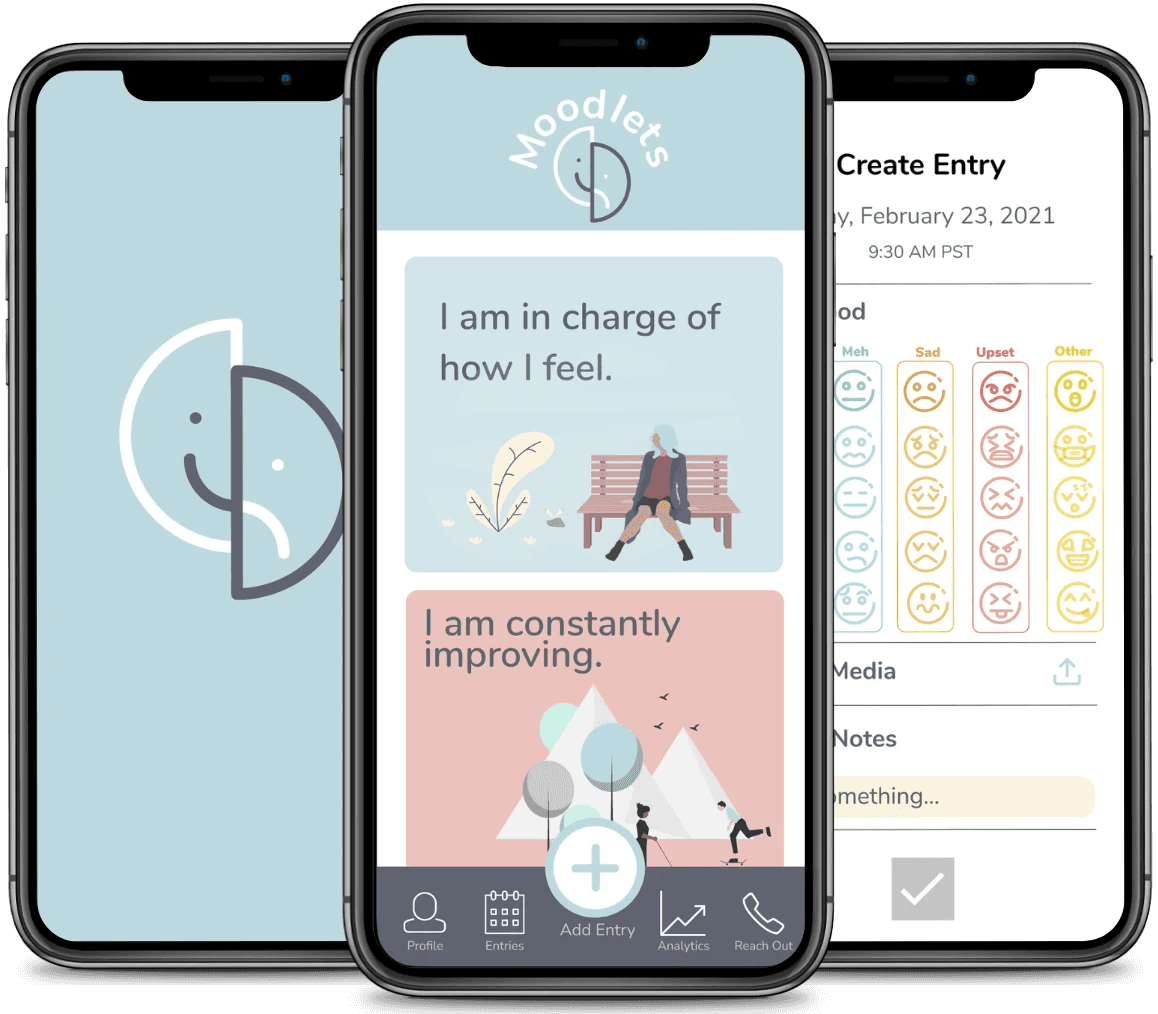
Moodlets: Mobile App that Shows Emotional Patterns & Connects Mental Health Support
A highly functional tool that brings a new level of insight into personal emotional trends and facilitates connections with health professionals.
Read Case Study
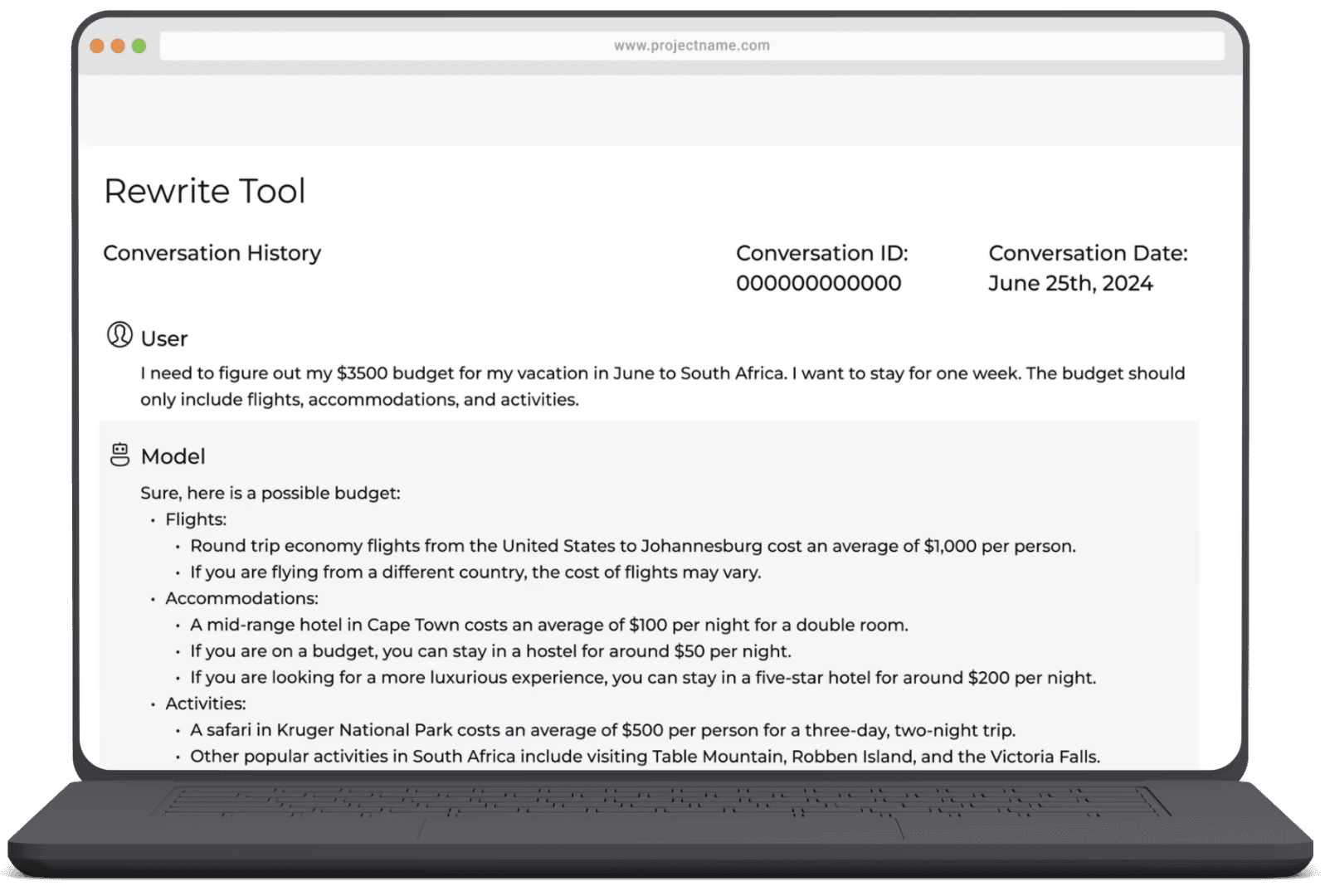
Gen AI LMM Training: Designing Safer, Smarter AI Interactions
Training a Large Language Model with Human-Centered, High-Quality Prompts
NEXT
Gen AI LMM Training: Designing Safer, Smarter AI Interactions
Training a Large Language Model with Human-Centered, High-Quality Prompts
Read Case Study
DocuCare: Empowering School Nurses through Better Documentation
A tracking tool born from the vision to not only facilitate but also illuminate the critical work of school nurses.
Read Case Study
DocuCare: Empowering School Nurses through Better Documentation
A tracking tool born from the vision to not only facilitate but also illuminate the critical work of school nurses.
Read Case Study
Moodlets: Mobile App that Shows Emotional Patterns & Connects Mental Health Support
A highly functional tool that brings a new level of insight into personal emotional trends and facilitates connections with health professionals.
Read Case Study
Gen AI LMM Training: Designing Safer, Smarter AI Interactions
Training a Large Language Model with Human-Centered, High-Quality Prompts
Read Case Study
Read Case Study
ReWA: A Visual Strategy to Promote Family & Community Empowerment
A modern, cohesive, and impactful visual identity that authentically reflects the mission of Refugee Women's Alliance—supporting refugee and immigrant women and their families.
Read Case Study
Moodlets: Mobile App that Shows Emotional Patterns & Connects Mental Health Support
A highly functional tool that brings a new level of insight into personal emotional trends and facilitates connections with health professionals.
Read Case Study
Gen AI LMM Training: Designing Safer, Smarter AI Interactions
Training a Large Language Model with Human-Centered, High-Quality Prompts