AI Marketing Copilot Platform
AI Marketing Copilot Platform
Overview
Overview
A Generative AI-powered marketing platform that redefines how marketers create, refine, and localize campaigns. By streamlining workflows and enhancing usability, it drove $12M in sales, unlocked $40M in opportunities, and earned stakeholder buy-in for future development.
A Generative AI-powered marketing platform that redefines how marketers create, refine, and localize campaigns. By streamlining workflows and enhancing usability, it drove $12M in sales, unlocked $40M in opportunities, and earned stakeholder buy-in for future development.
My Role
My Role
As the product designer, I transformed a developer-led prototype into a cohesive AI copilot experience that streamlined marketing campaign creation from brief to finished copy tailored to real user needs— reducing brief creation time by 80% and improving content accuracy and usability.
As the product designer, I transformed a developer-led prototype into a cohesive AI copilot experience that streamlined marketing campaign creation from brief to finished copy tailored to real user needs— reducing brief creation time by 80% and improving content accuracy and usability.
** Due to honoring the terms of my confidentiality agreements, the artifacts have been reconstructed and should be considered as illustrative. All examples have also been scrubbed for PII and sensitive details.
** Due to honoring the terms of my confidentiality agreements, the artifacts have been reconstructed and should be considered as illustrative. All examples have also been scrubbed for PII and sensitive details.
Project Type
Project Type
Team
Team
Client
Client
Timeline
Timeline
Tools
Tools
B2B, SaaS Platform, Gen AI
B2B, SaaS Platform, Gen AI
2 Devs, 1 PM, 1 Product Designer (me)
2 Devs, 1 PM, 1 Product Designer (me)
FAANG Company
FAANG Company
6 weeks, Agile Sprints
6 weeks, Agile Sprints
Figma, Jira
Figma, Jira
Impact
Impact
Delivered a high-fidelity, working prototype that secured client buy-in and funding within 6 weeks.
Delivered a high-fidelity, working prototype that secured client buy-in and funding within 6 weeks.
$12M in confirmed sales
Platform successfully pitched and funded, generating immediate revenue
$12M in confirmed sales
Platform successfully pitched and funded, generating immediate revenue
$40M+ in pipeline opportunities
Projected revenue from expanded client adoption
$40M+ in pipeline opportunities
Projected revenue from expanded client adoption
3 flexible entry points
Increased accessibility for users at different readiness levels
3 flexible entry points
Increased accessibility for users at different readiness levels
5 streamlined phases
From brief to localized, downloadable campaign copy in one cohesive flow
5 streamlined phases
From brief to localized, downloadable campaign copy in one cohesive flow
Problem
Problem
Marketing teams at our FAANG client were stuck in a slow, manual process for creating campaign copy. The existing tool required marketers to arrive with fully-formed briefs and navigate complex requirement forms upfront—creating bottlenecks and slowing time-to-market.
The platform needed to evolve from a static form-based workflow into an AI-powered copilot that could guide users from rough ideas to polished, localized campaign copy with speed and accuracy.
Marketing teams at our FAANG client were stuck in a slow, manual process for creating campaign copy. The existing tool required marketers to arrive with fully-formed briefs and navigate complex requirement forms upfront—creating bottlenecks and slowing time-to-market.
The platform needed to evolve from a static form-based workflow into an AI-powered copilot that could guide users from rough ideas to polished, localized campaign copy with speed and accuracy.
The Challenge
The Challenge
Transform a developer-built prototype into a scalable, intuitive experience that would secure client funding and adoption.
What was at stake:
∙ Slow campaign turnaround times
∙ Manual bottlenecks in brief creation
∙ Limited platform scalability
∙ $12M+ funding decision riding on this prototype
Transform a developer-built prototype into a scalable, intuitive experience that would secure client funding and adoption.
What was at stake:
∙ Slow campaign turnaround times
∙ Manual bottlenecks in brief creation
∙ Limited platform scalability
∙ $12M+ funding decision riding on this prototype
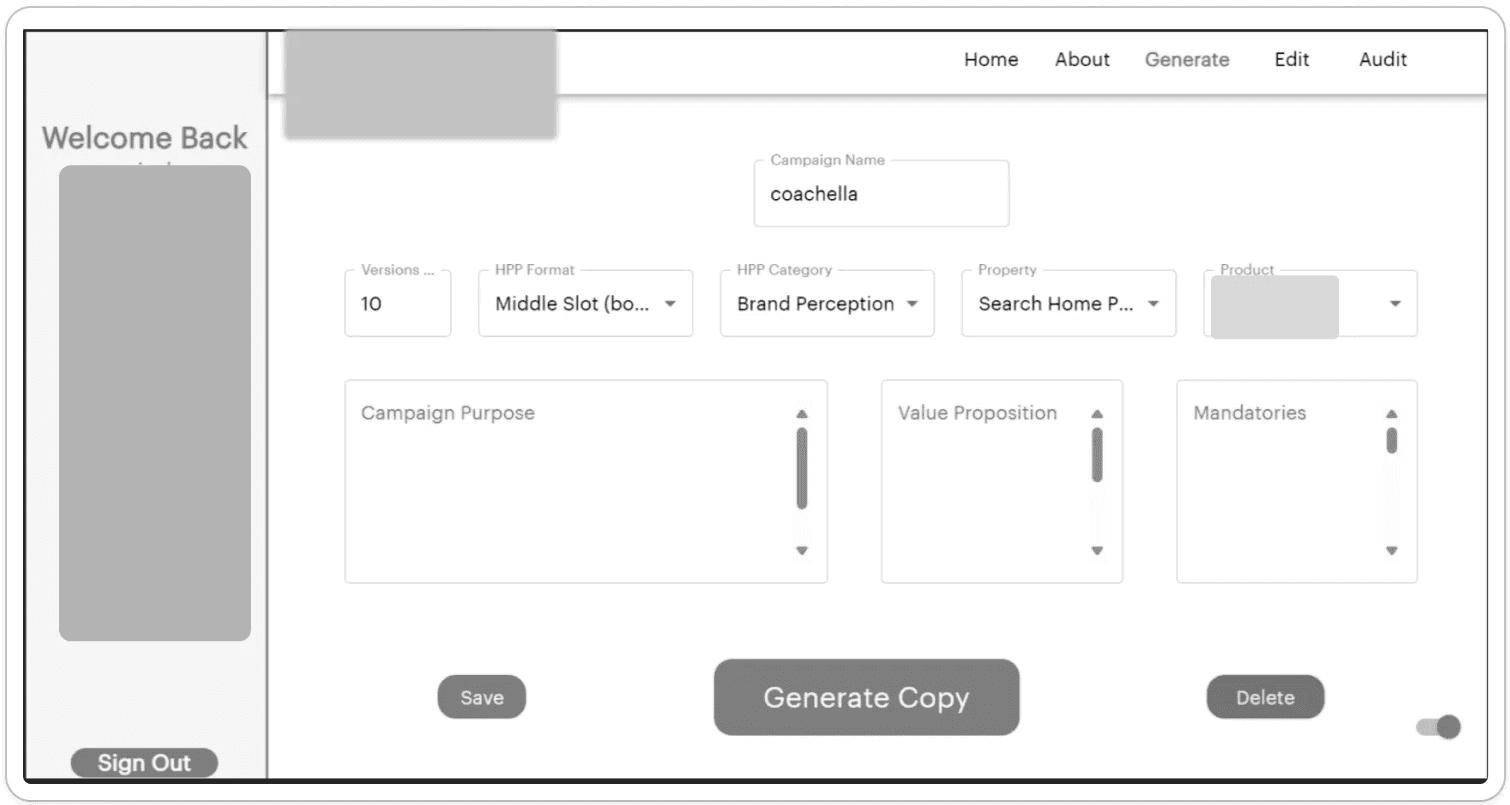
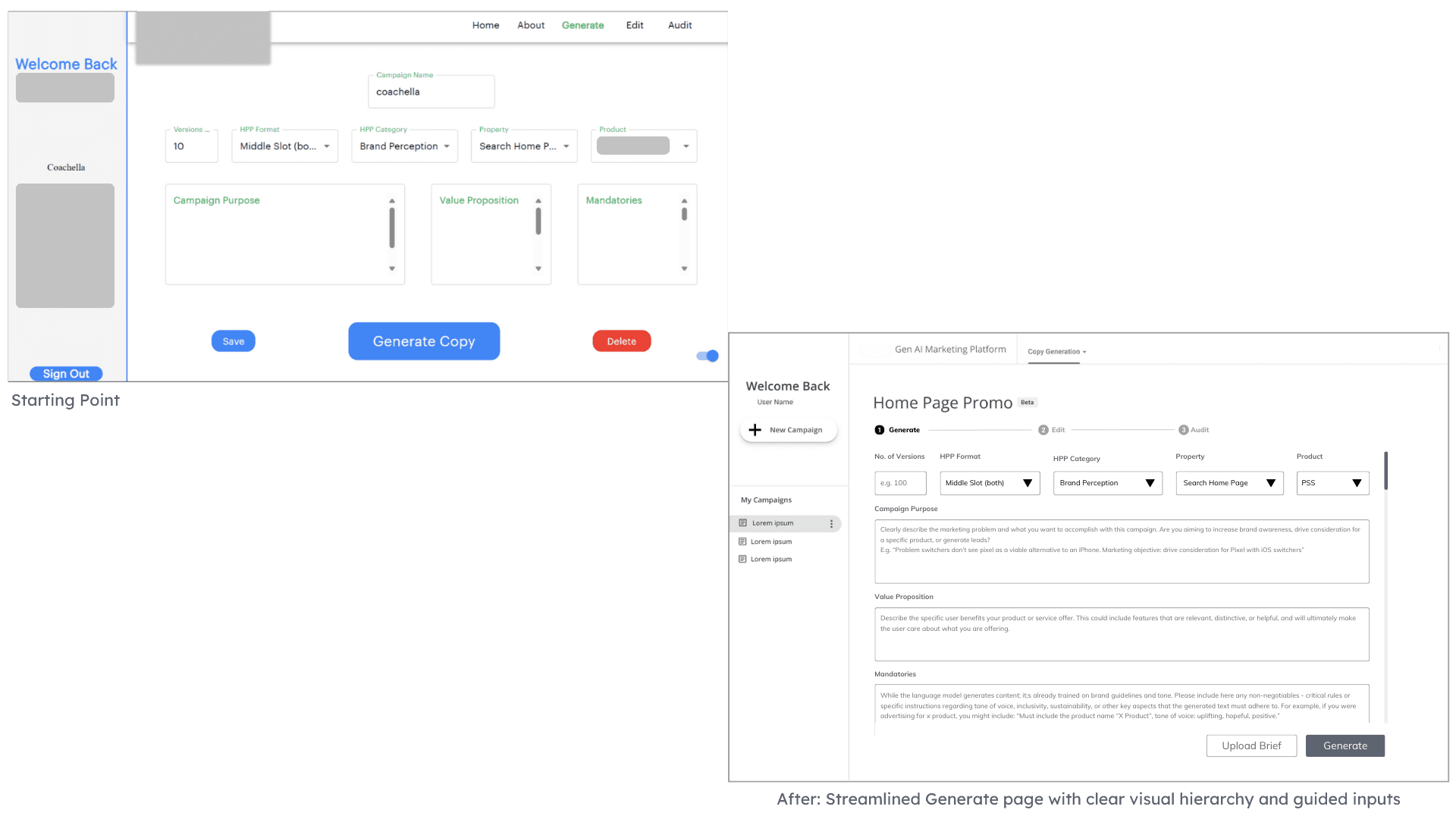
Original developer-built interface. Complex requirements form created friction upfront.
Original developer-built interface. Complex requirements form created friction upfront.
Solution
Solution
I designed an AI-assisted campaign builder that met marketers where they were—whether they arrived with a complete brief, a rough idea, or nothing at all. The platform intelligently guided users through brief creation, copy generation, editing, and multi-language localization in one seamless flow.
I designed an AI-assisted campaign builder that met marketers where they were—whether they arrived with a complete brief, a rough idea, or nothing at all. The platform intelligently guided users through brief creation, copy generation, editing, and multi-language localization in one seamless flow.
Three intelligent entry points:
Three intelligent entry points:
1. Import existing brief - For users with completed requirements
2. Upload brief via chat - AI extracts requirements from existing documents
3. Co-create with AI (recommended) - Conversational brief builder guides users through questions
1. Import existing brief - For users with completed requirements
2. Upload brief via chat - AI extracts requirements from existing documents
3. Co-create with AI (recommended) - Conversational brief builder guides users through questions
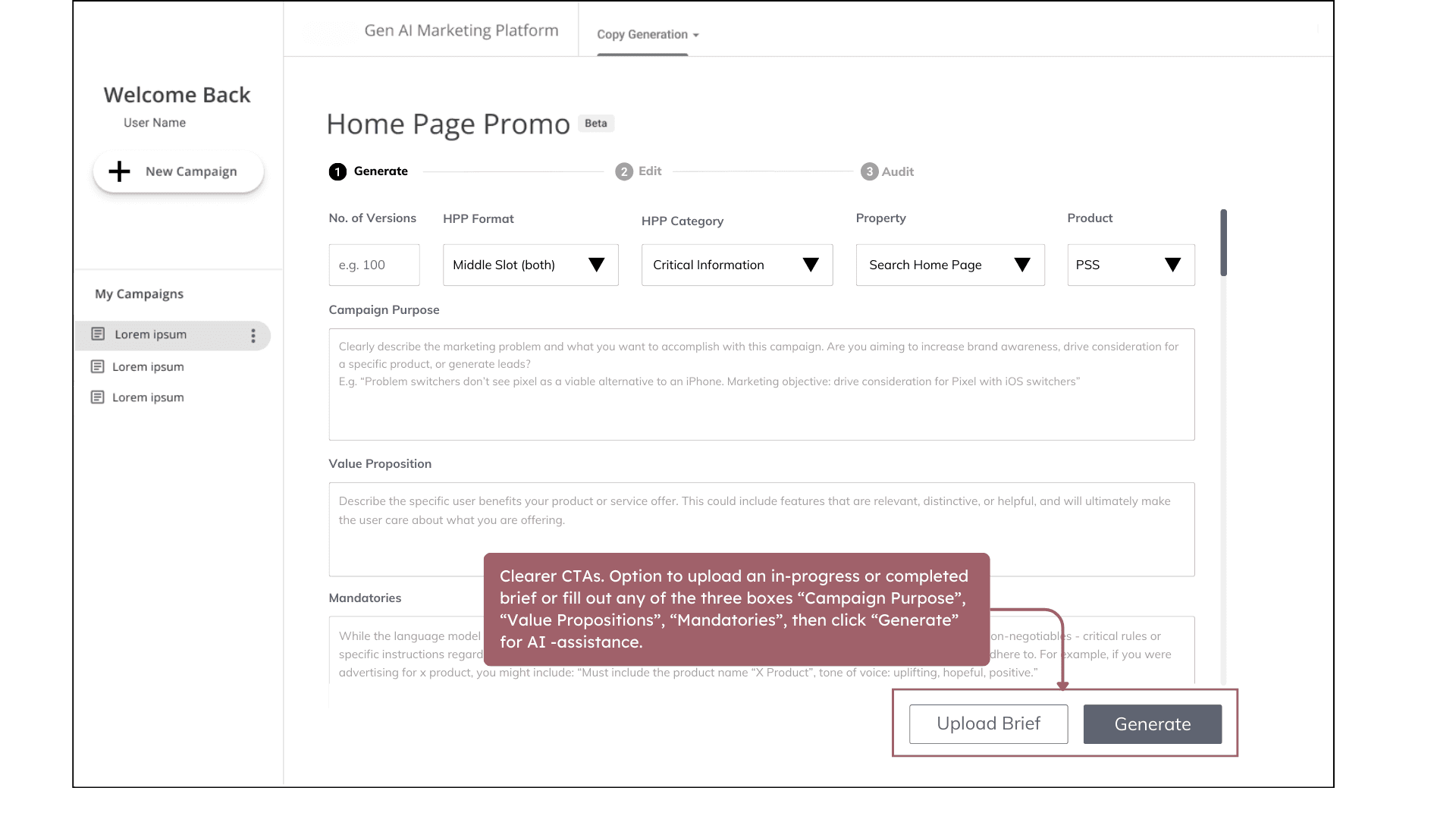
Design Process
Design Process
I joined at the discovery phase when two developers had just started building base functionality for the “Home Page Promo” (HPP) flow. My role was to bring UX clarity, design cohesion, and user-centered thinking to the experience.
I joined at the discovery phase when two developers had just started building base functionality for the “Home Page Promo” (HPP) flow. My role was to bring UX clarity, design cohesion, and user-centered thinking to the experience.
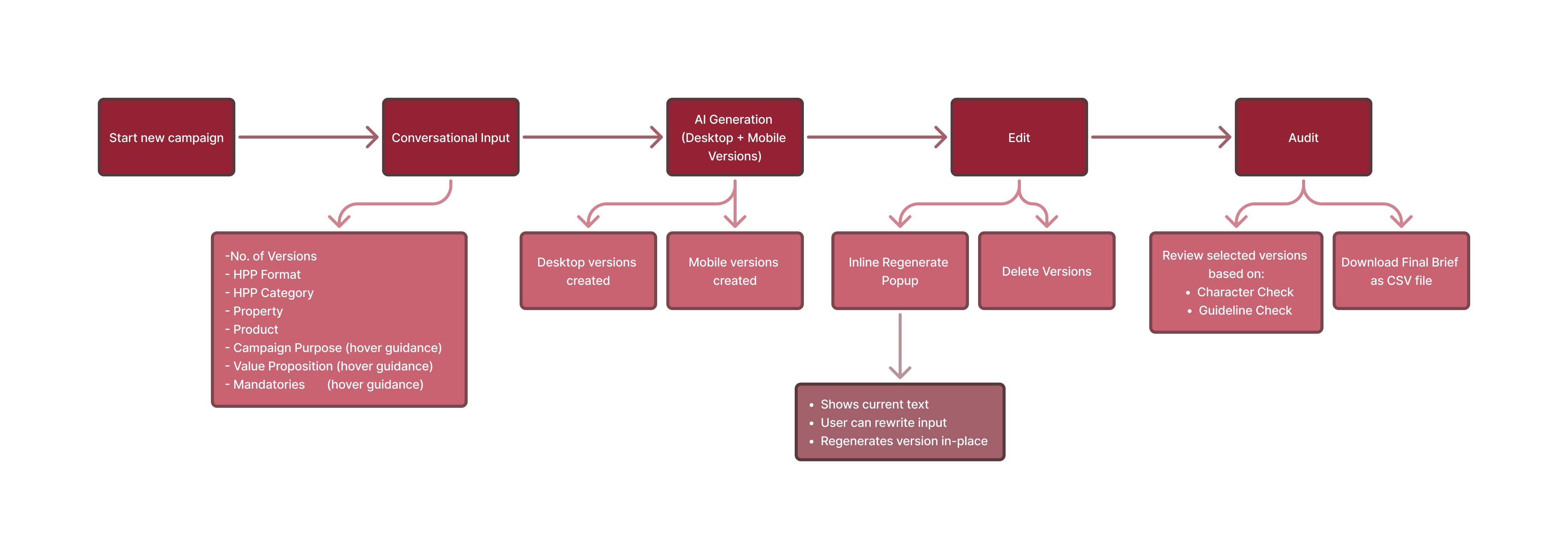
Initial user journey mapping - identifying friction points and optimization opportunities
Initial user journey mapping - identifying friction points and optimization opportunities
Research & Discovery
Research & Discovery
I started by collaborating with the developers and PM to understand both the client's business needs and the technical approach already underway.
I started by collaborating with the developers and PM to understand both the client's business needs and the technical approach already underway.
What I Uncovered:
Static requirements form overwhelmed users upfront
No guidance for marketers without complete briefs
Disconnected steps from brief → generation → editing → localization
Missing visual flow indicators (users didn't know where they were in the journey)
What I Uncovered:
Static requirements form overwhelmed users upfront
No guidance for marketers without complete briefs
Disconnected steps from brief → generation → editing → localization
Missing visual flow indicators (users didn't know where they were in the journey)
Key Opportunity Identified:
Key Opportunity Identified:
Rather than forcing users into a single rigid path, I designed flexible entry points that adapted to different user readiness levels—making the platform more accessible and scalable.
Rather than forcing users into a single rigid path, I designed flexible entry points that adapted to different user readiness levels—making the platform more accessible and scalable.
Rapid High-Fidelity Iteration
Rapid High-Fidelity Iteration
Given the 6-week timeline and need to pitch for funding, I moved quickly into high-fidelity wireframing. Every design decision had to be immediately implementable—changes were developed same-day.
Given the 6-week timeline and need to pitch for funding, I moved quickly into high-fidelity wireframing. Every design decision had to be immediately implementable—changes were developed same-day.
Design principle: Progressive disclosure
Design principle: Progressive disclosure
Instead of overwhelming users with all requirements upfront, I structured the experience to:
Guide users through conversational questions (chatbot flow)
Build hierarchy in CTAs and form inputs
Pre-populate the Generate page after brief completion
Visualize progress across Generate → Edit → Audit → Localize
Instead of overwhelming users with all requirements upfront, I structured the experience to:
Guide users through conversational questions (chatbot flow)
Build hierarchy in CTAs and form inputs
Pre-populate the Generate page after brief completion
Visualize progress across Generate → Edit → Audit → Localize
The Chatbot Brief Builder
The Chatbot Brief Builder
I designed a conversational AI flow that mirrored the existing Email Brief Builder pattern but optimized for the HPP campaign context.
I designed a conversational AI flow that mirrored the existing Email Brief Builder pattern but optimized for the HPP campaign context.
How it worked
How it worked
The chatbot asked targeted questions to gather requirements:
Campaign purpose
Value propositions
Mandatory requirements
Product selection (auto-suggested based on campaign purpose)
HPP format (multiple choice)
Category (multiple choice)
Once complete, users landed on the Generate page with all fields pre-populated—ready to review and proceed.
The chatbot asked targeted questions to gather requirements:
Campaign purpose
Value propositions
Mandatory requirements
Product selection (auto-suggested based on campaign purpose)
HPP format (multiple choice)
Category (multiple choice)
Once complete, users landed on the Generate page with all fields pre-populated—ready to review and proceed.
Design consideration: Handling user behavior
Design consideration: Handling user behavior
I mapped edge cases like:
What if a user starts with chatbot but switches to manual form?
Should they be able to return to brief builder? (Yes, with confirmation CTA)
How do we handle conflicting inputs without erasing work?
I mapped edge cases like:
What if a user starts with chatbot but switches to manual form?
Should they be able to return to brief builder? (Yes, with confirmation CTA)
How do we handle conflicting inputs without erasing work?
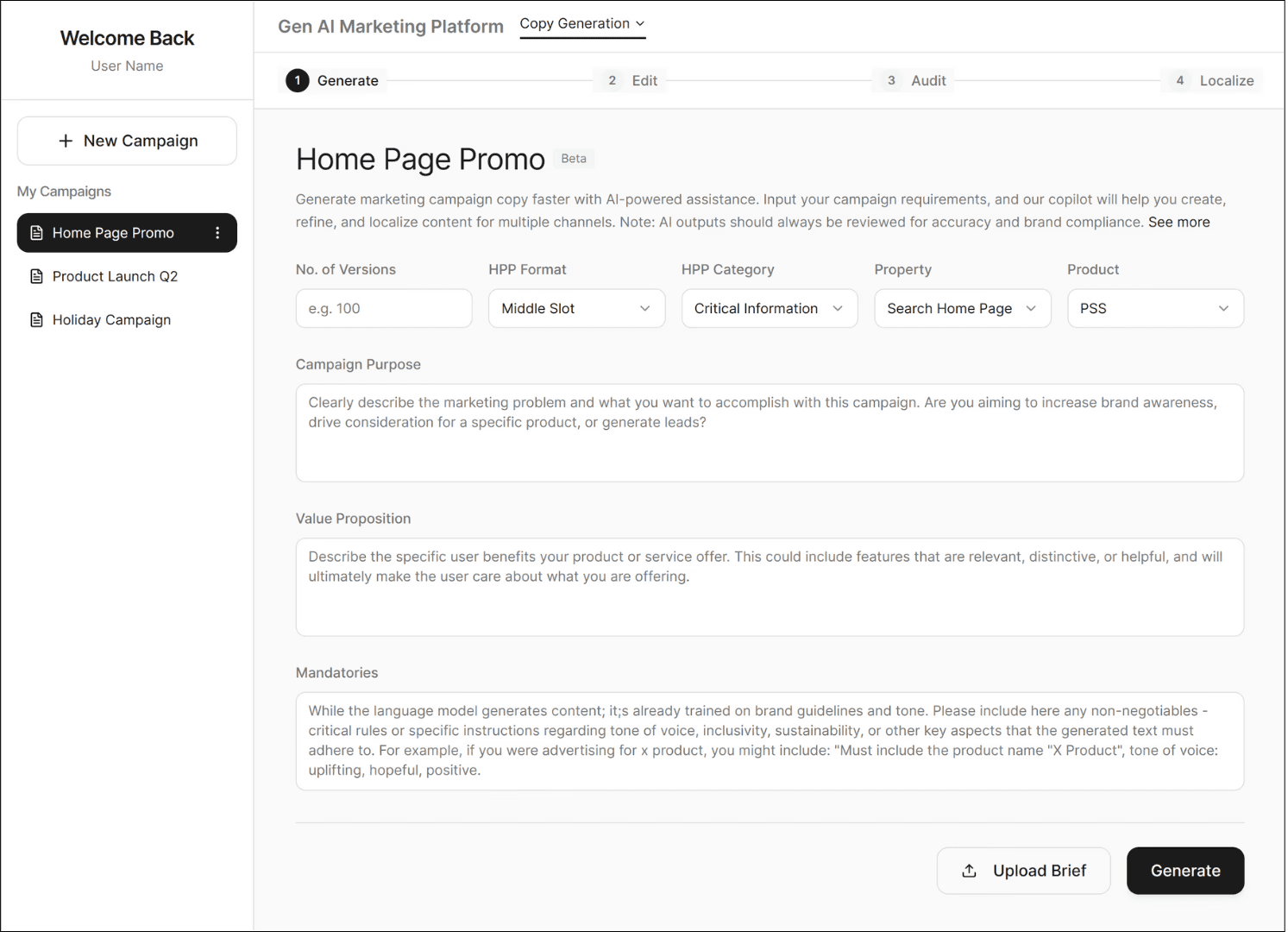
Generate
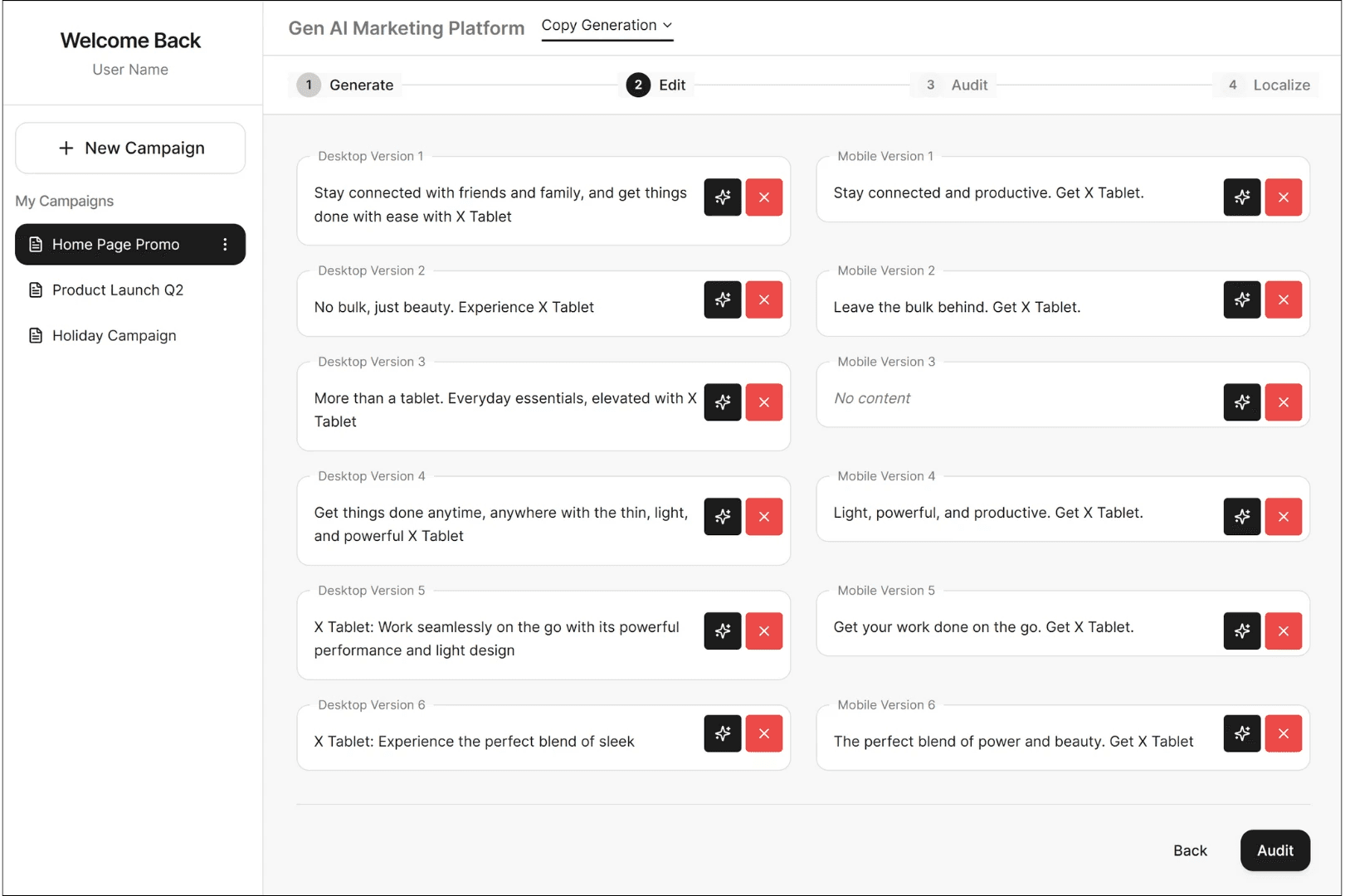
Edit
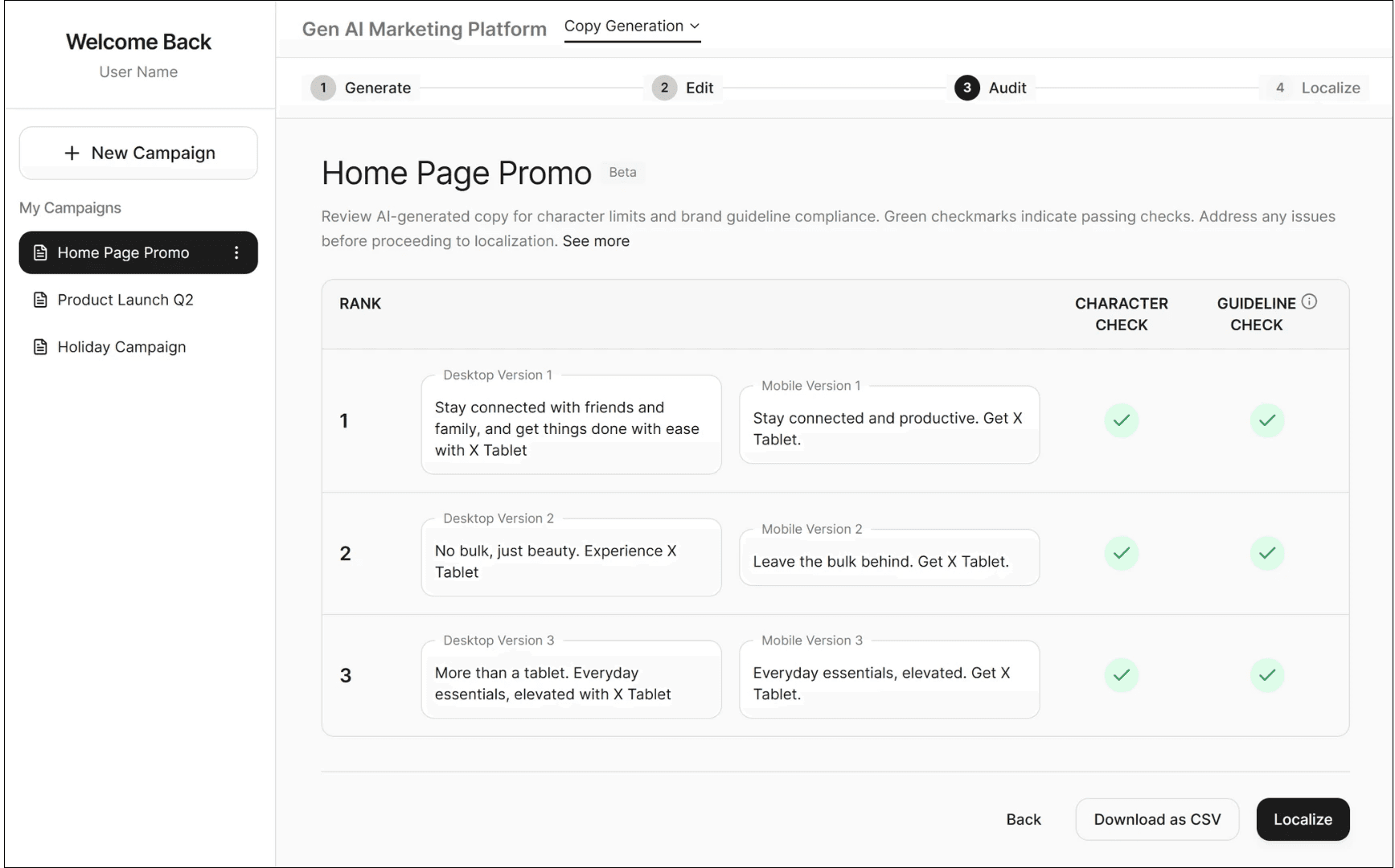
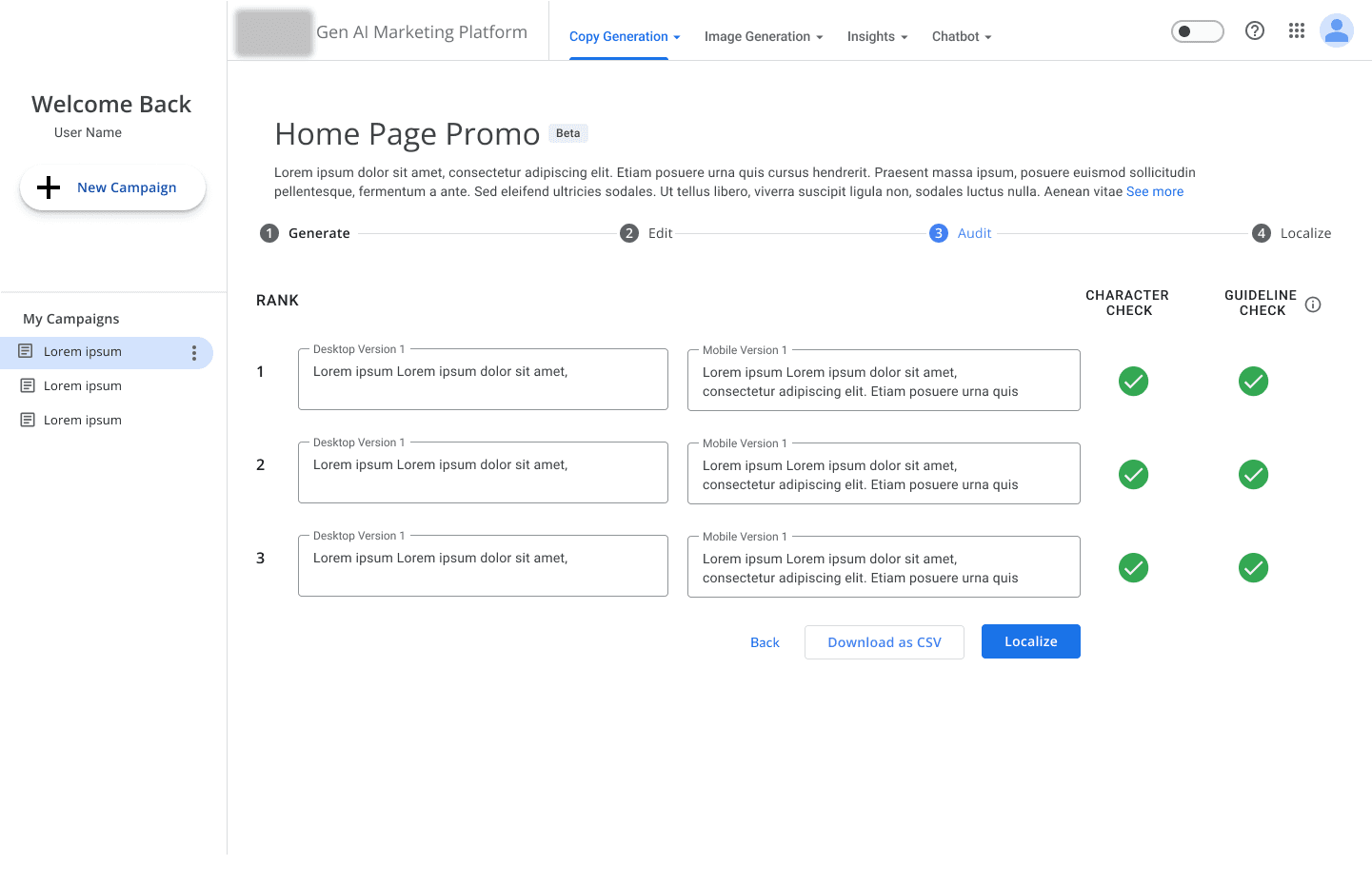
Audit
Generate
Edit
Audit
AI-powered brief builder - guiding users through requirements conversationally
AI-powered brief builder - guiding users through requirements conversationally
Adding Visual Flow: Audit → Localize
Adding Visual Flow: Audit → Localize
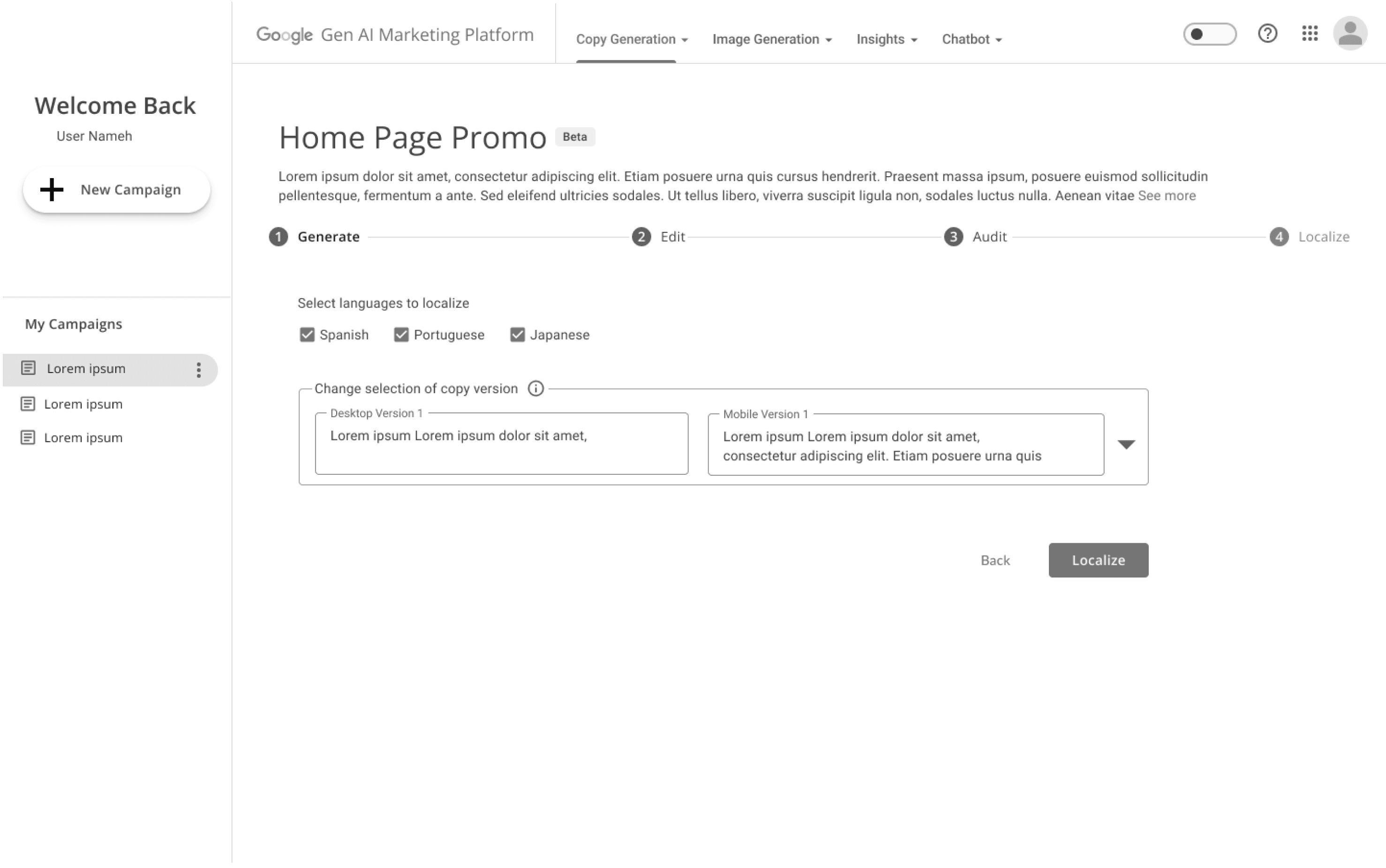
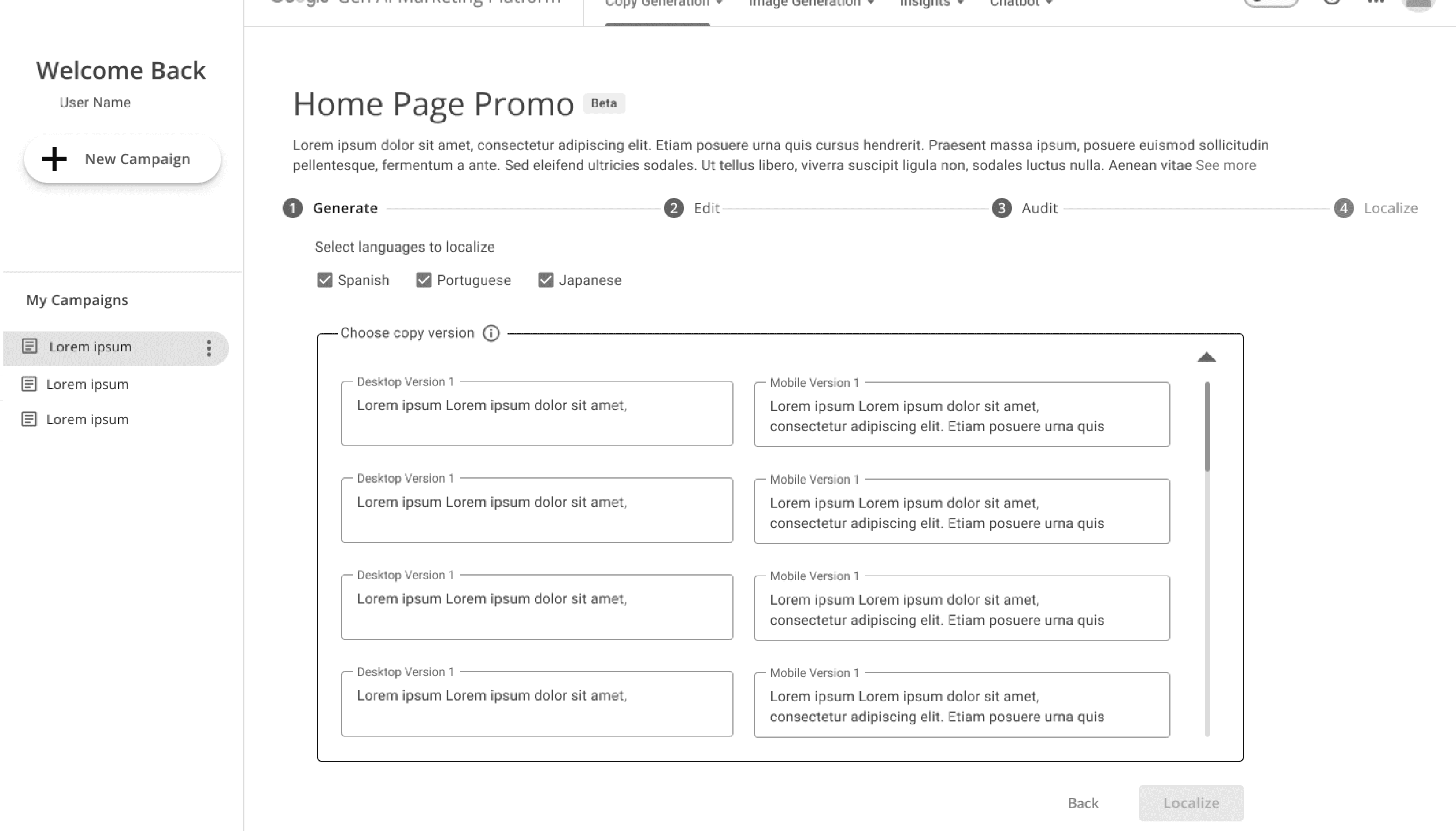
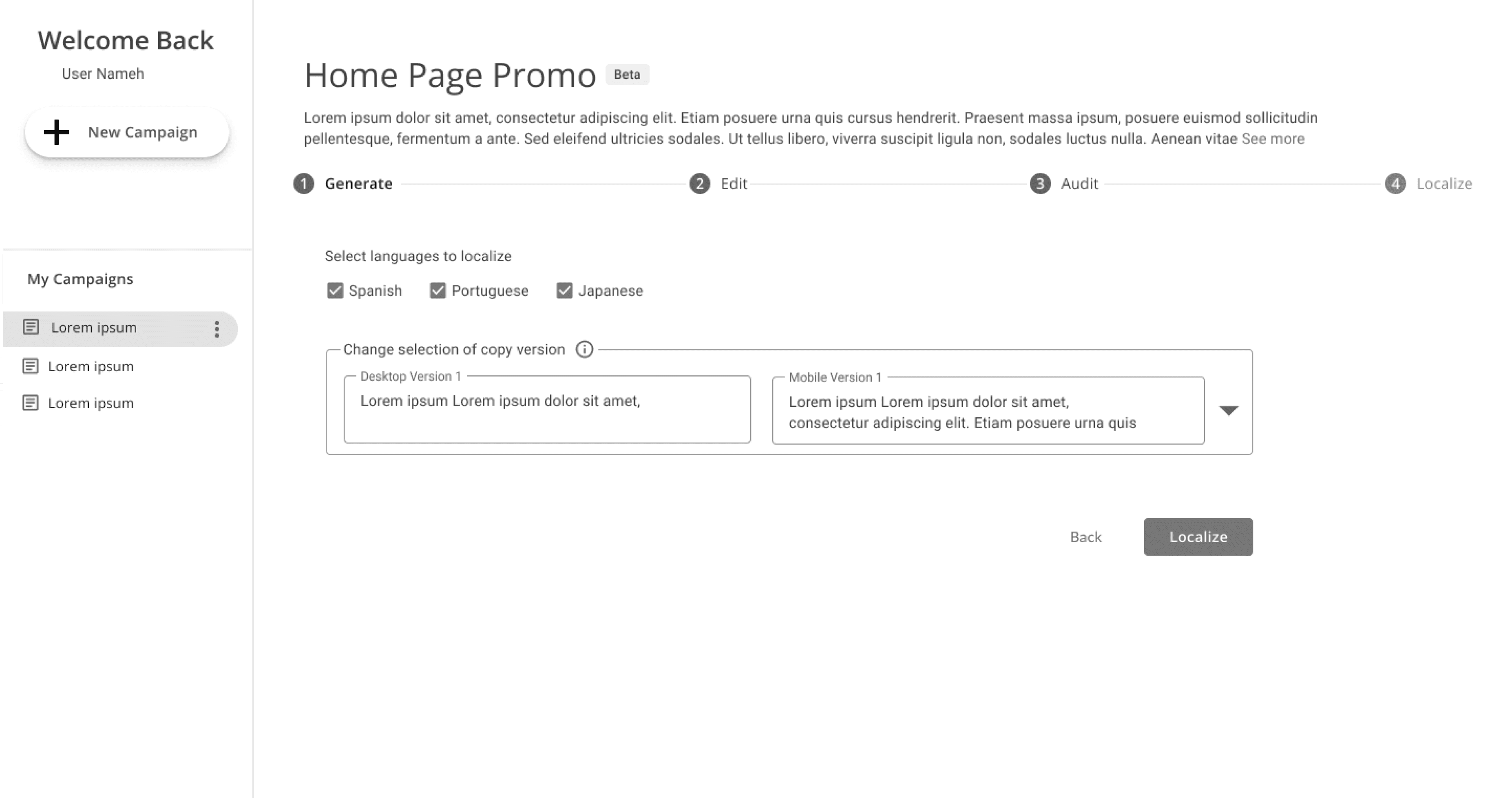
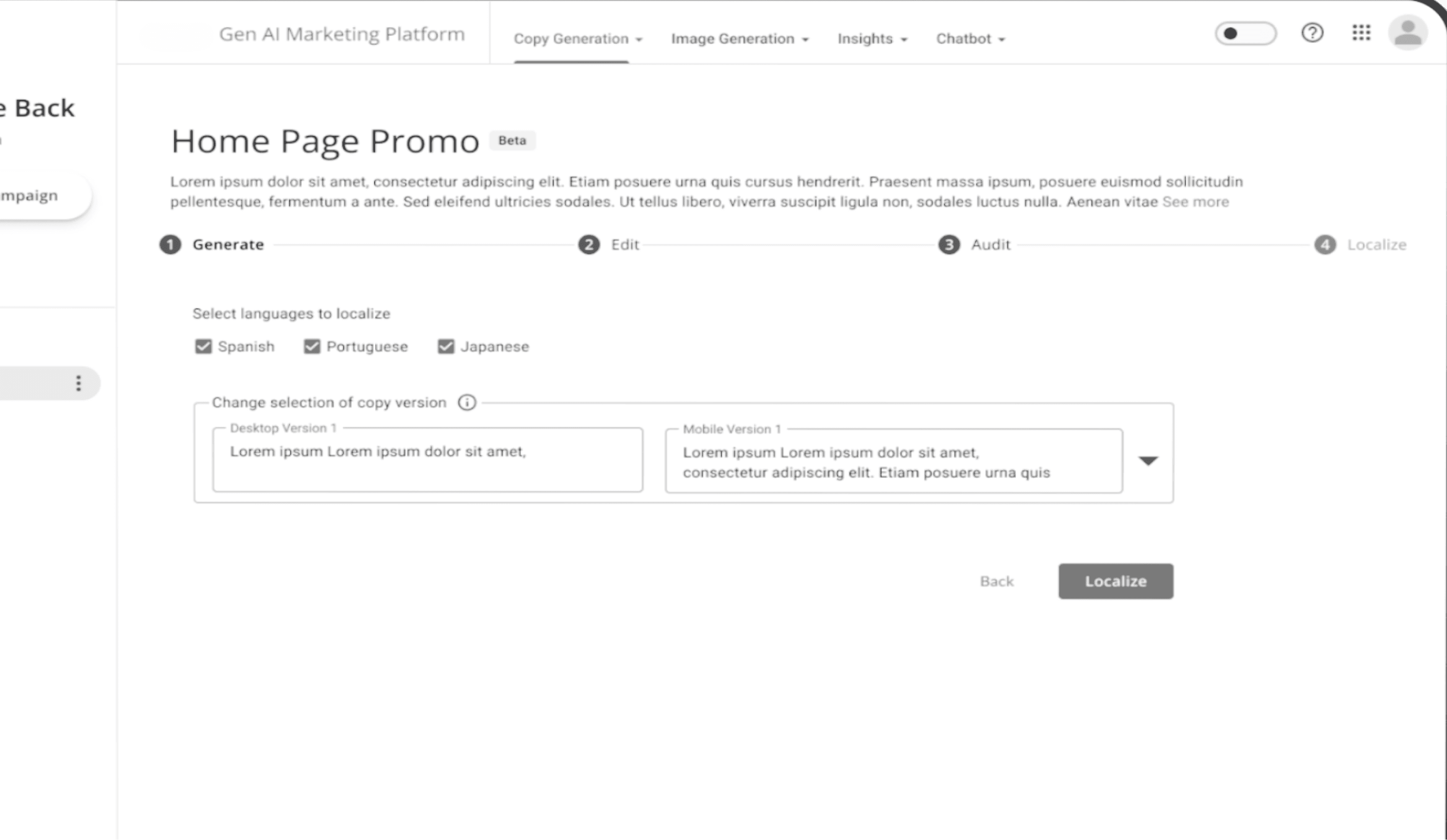
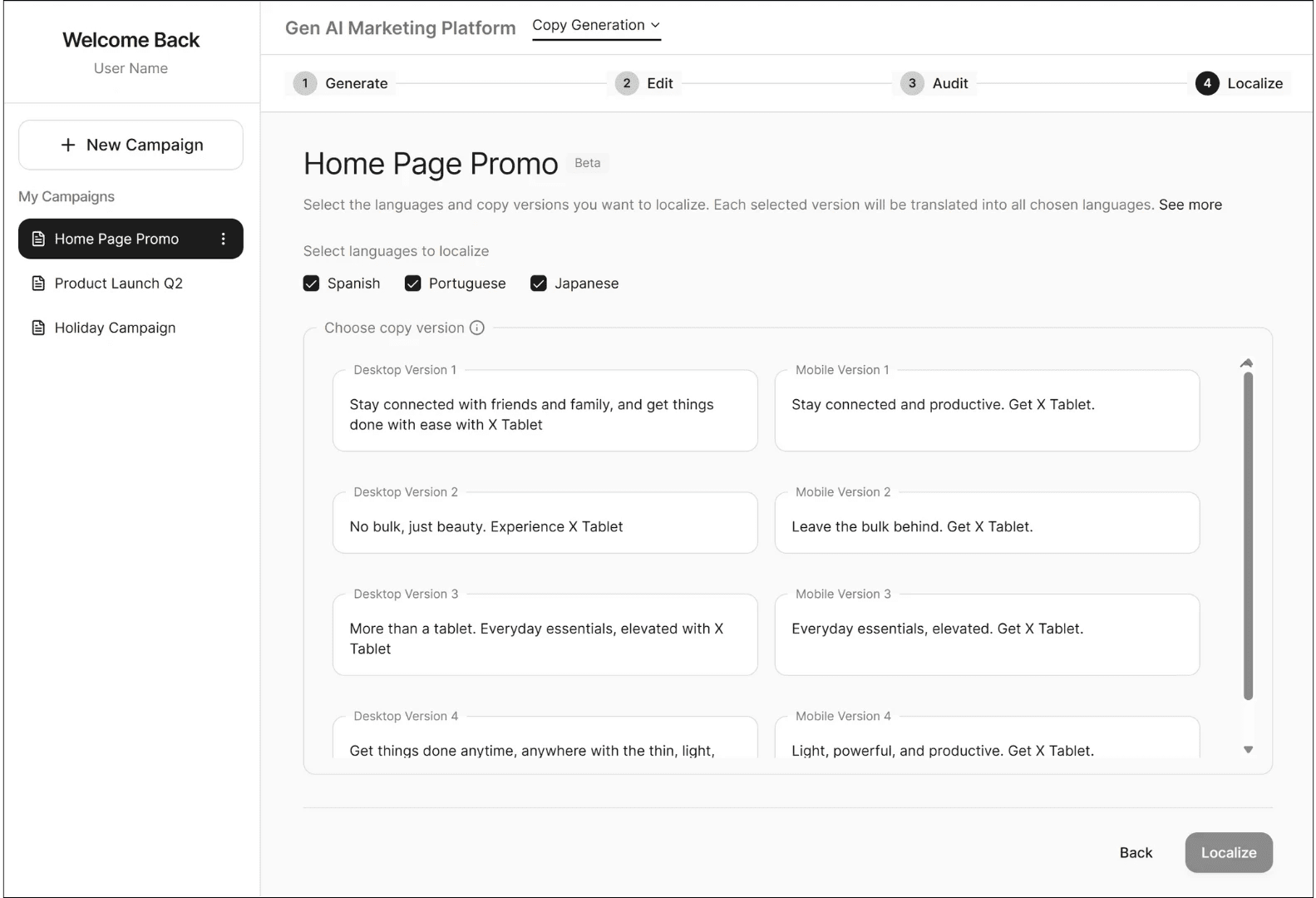
Mid-project, I received a new user story: add a visual stepper showing Generate → Edit → Audit, plus a new Localize phase at the end.
Mid-project, I received a new user story: add a visual stepper showing Generate → Edit → Audit, plus a new Localize phase at the end.
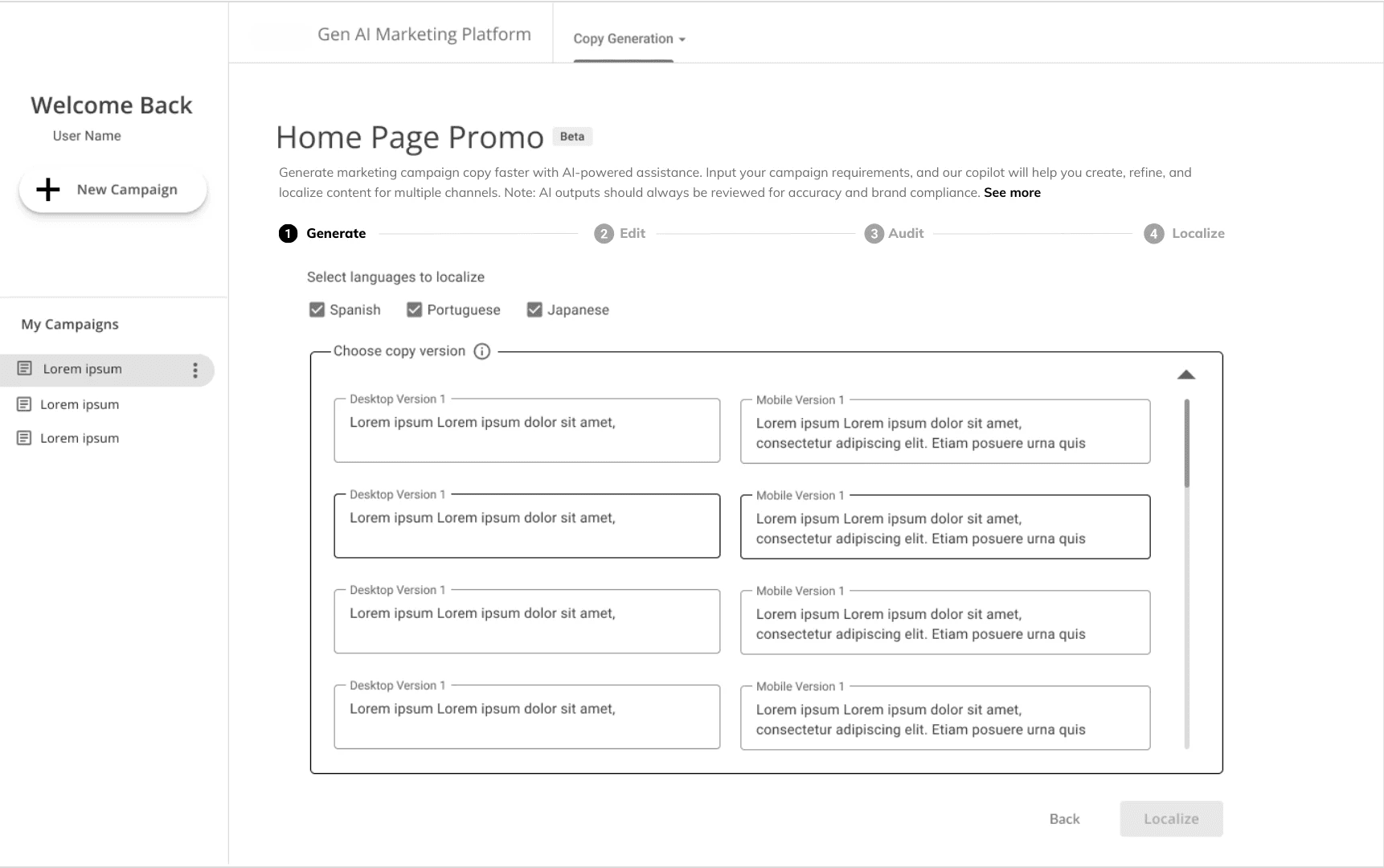
The localization challenge
The localization challenge
Users needed to:
Select up to 3 languages at once
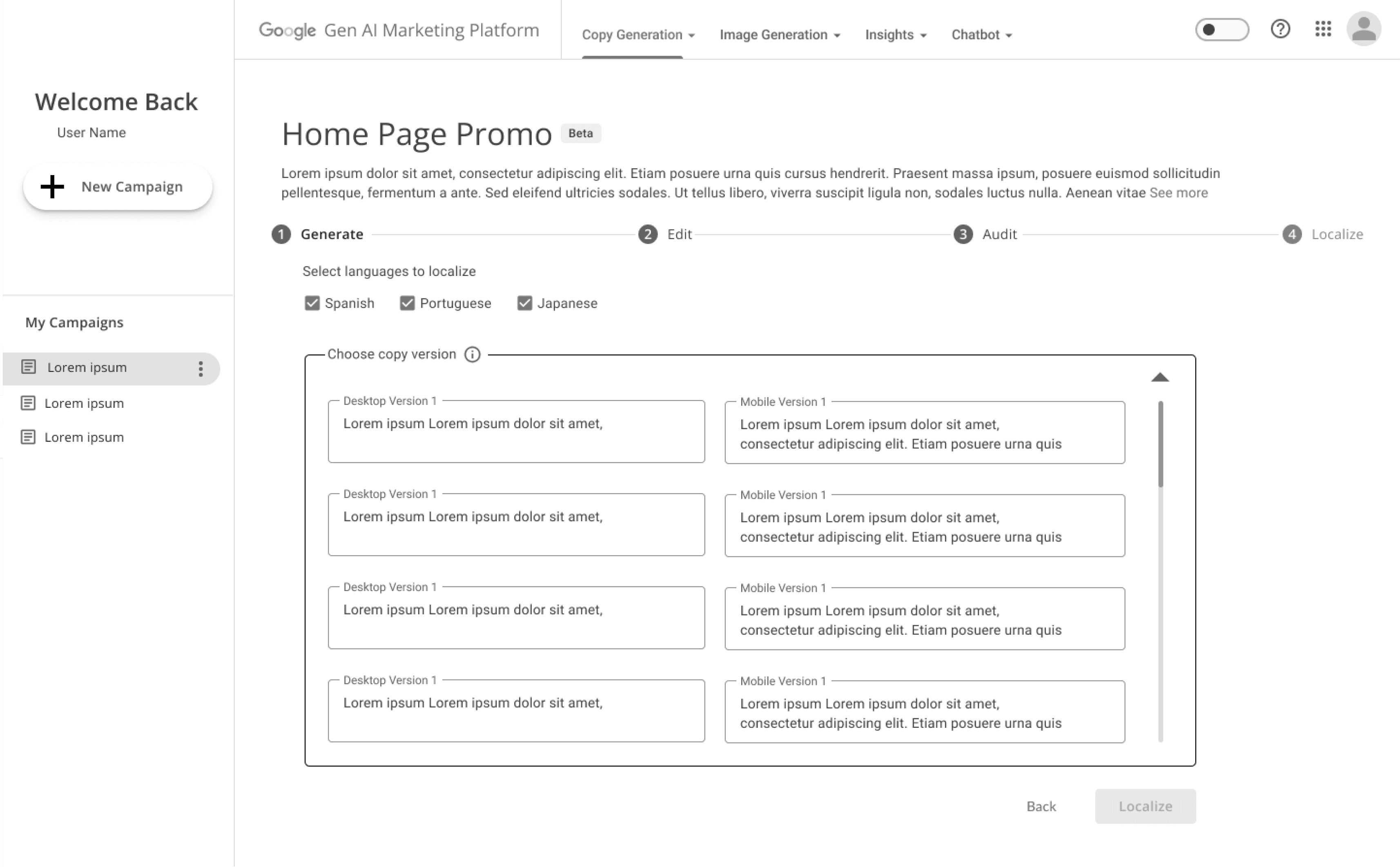
Choose copy versions (desktop vs. mobile)
Maintain context of which version belonged to which language
Users needed to:
Select up to 3 languages at once
Choose copy versions (desktop vs. mobile)
Maintain context of which version belonged to which language
Iteration #1: Dropdown menus
Iteration #1: Dropdown menus
Too hidden, didn't show selections clearly.
Too hidden, didn't show selections clearly.
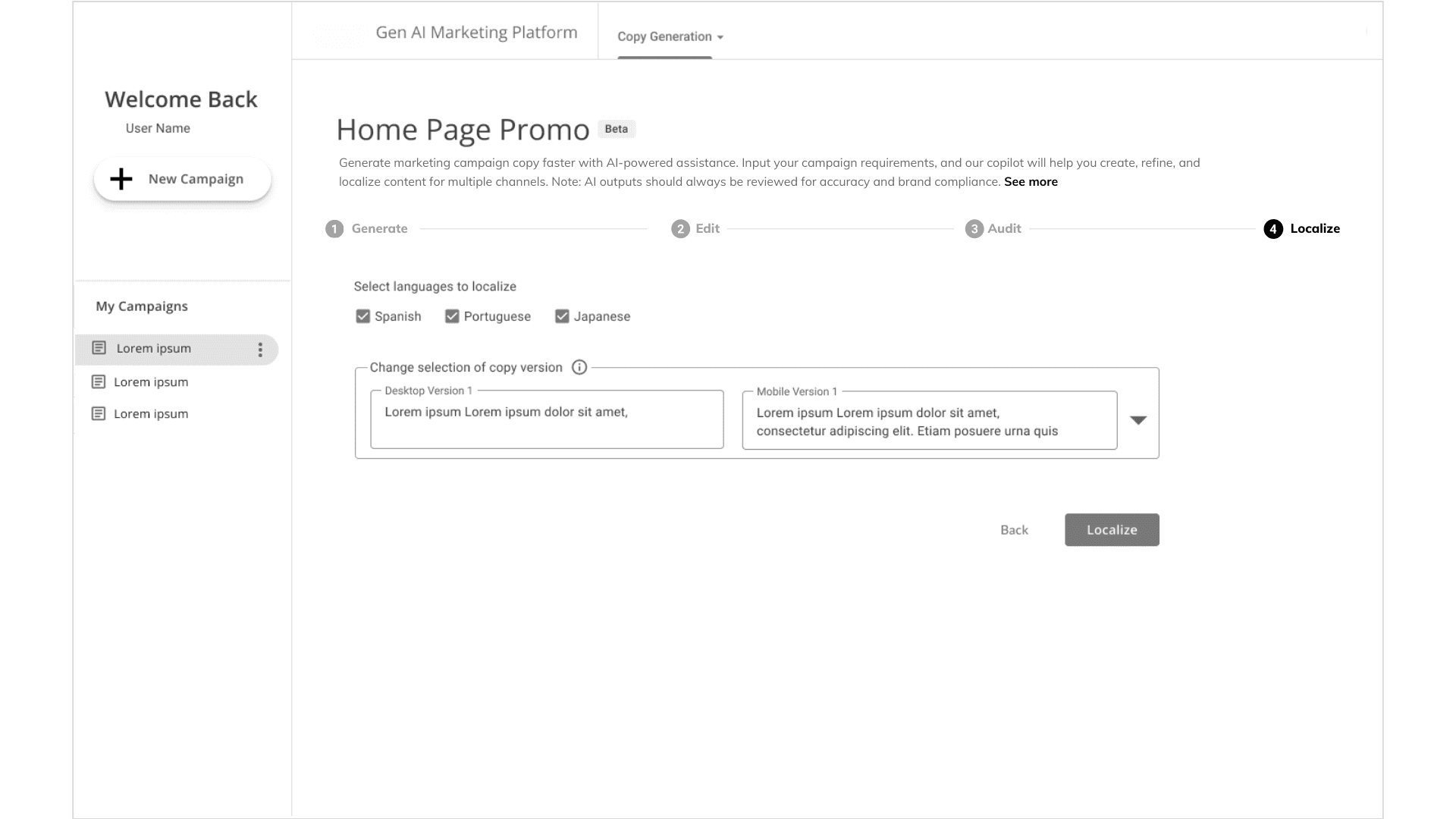
Iteration #2: Multiple selection (select all that apply)
Iteration #2: Multiple selection (select all that apply)
Too cluttered when dealing with language + version combinations
Too cluttered when dealing with language + version combinations
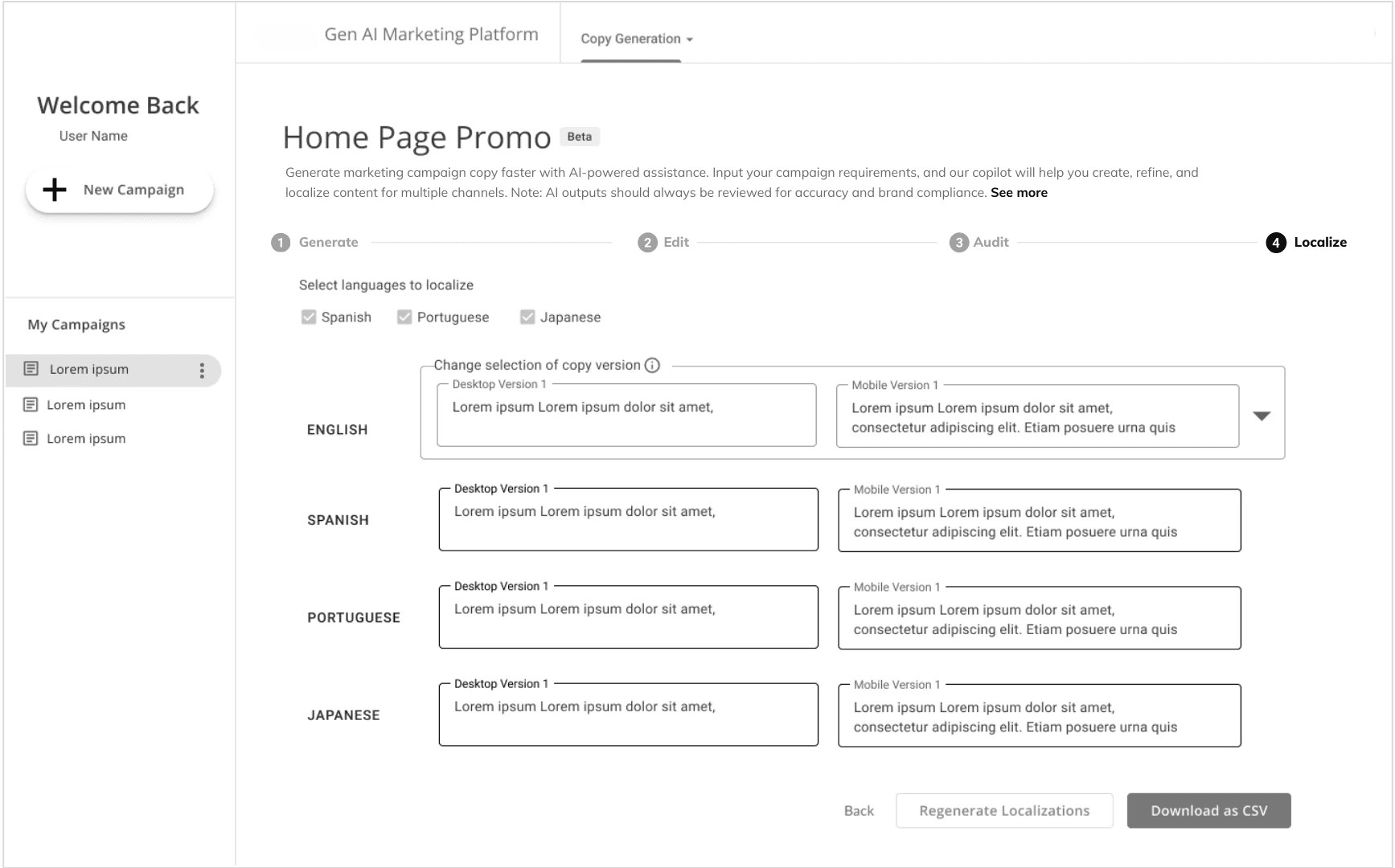
Final solution: Hybrid approach
Final solution: Hybrid approach
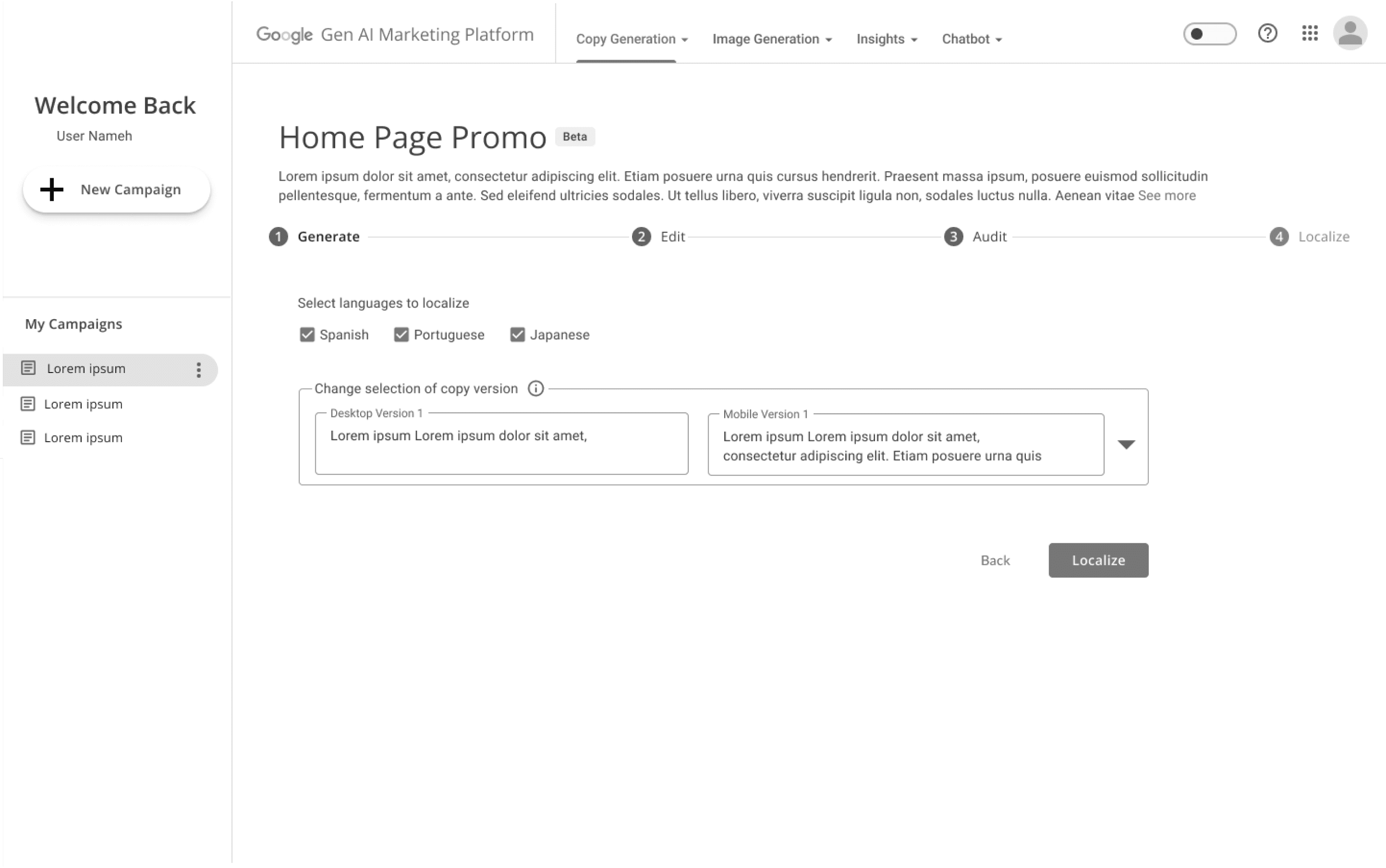
Language selection: Multi-select checkboxes (select all that apply)
Version selection: Dropdown per language showing desktop/mobile options
Constraint: Both versions required initially (future state would allow individual selection)
Language selection: Multi-select checkboxes (select all that apply)
Version selection: Dropdown per language showing desktop/mobile options
Constraint: Both versions required initially (future state would allow individual selection)
Same-Day Implementation Constraint
Same-Day Implementation Constraint
Because we were building a working prototype for a funding pitch, design and development happened in tight cycles. Any design change had to be:
• Implementable within hours
• Technically feasible with existing Gen AI integration
• Visually polished enough for executive presentation
Because we were building a working prototype for a funding pitch, design and development happened in tight cycles. Any design change had to be:
• Implementable within hours
• Technically feasible with existing Gen AI integration
• Visually polished enough for executive presentation
This constraint forced me to:
This constraint forced me to:
Prioritize high-impact design decisions
Collaborate tightly with developers on feasibility
Validate interaction patterns quickly
Prioritize high-impact design decisions
Collaborate tightly with developers on feasibility
Validate interaction patterns quickly
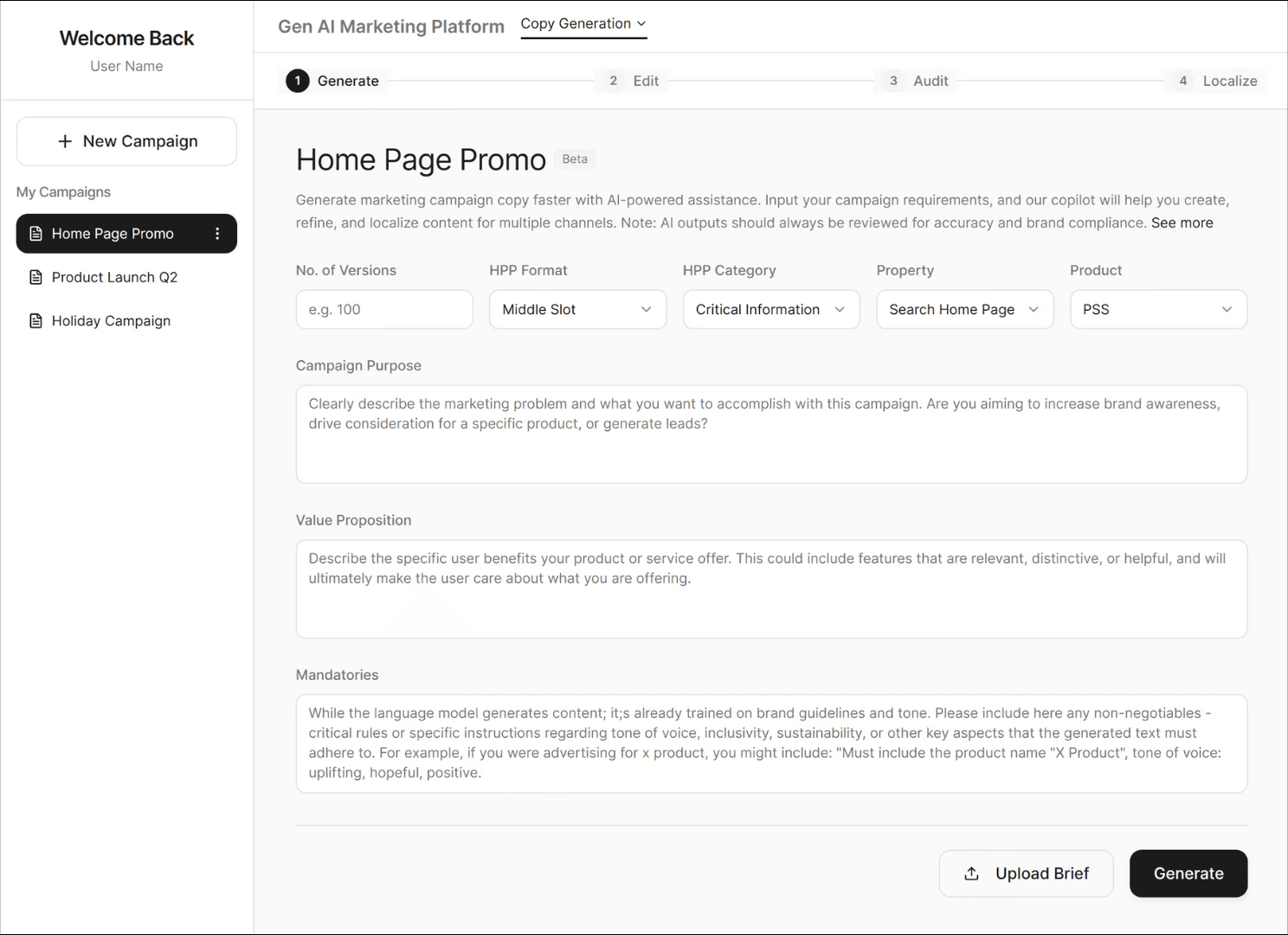
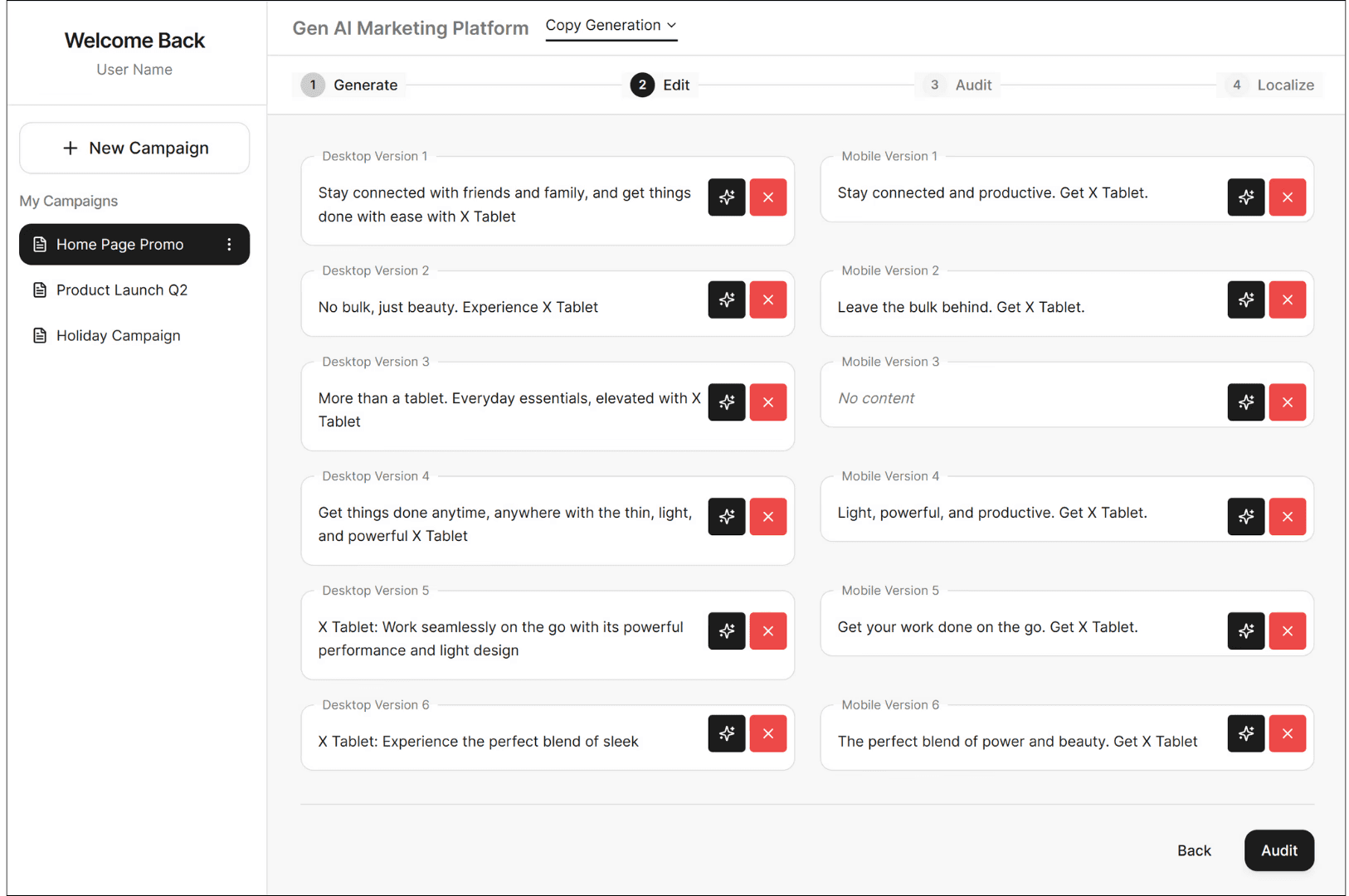
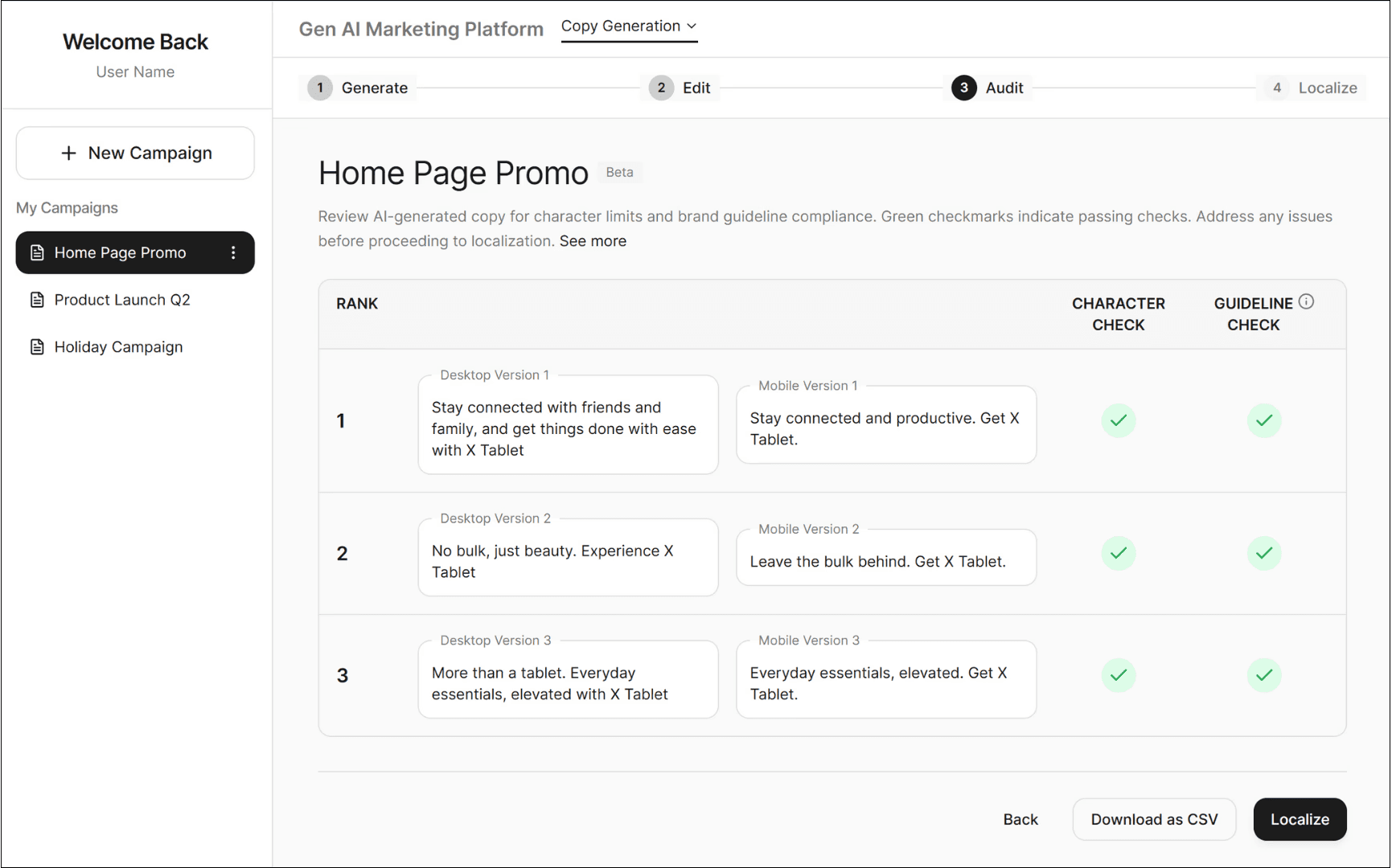
Final Experience Flow
Final Experience Flow
Generate → User creates brief (via chatbot or manual input)
Edit → AI generates copy variations, user refines
Audit → Review and validate AI-generated content
Localize → Select languages + versions (desktop/mobile)
Download → Export as CSV, regenerate variations as needed
Users could jump back to any phase to regenerate content with AI—creating a flexible, non-linear workflow that adapted to real-world campaign iteration needs.
Generate → User creates brief (via chatbot or manual input)
Edit → AI generates copy variations, user refines
Audit → Review and validate AI-generated content
Localize → Select languages + versions (desktop/mobile)
Download → Export as CSV, regenerate variations as needed
Users could jump back to any phase to regenerate content with AI—creating a flexible, non-linear workflow that adapted to real-world campaign iteration needs.
Reflection & Takeaways
Reflection & Takeaways
This was my first experience designing an AI-powered platform under tight funding pressure, and it taught me critical lessons about speed, stakeholder alignment, and business-driven design.
This was my first experience designing an AI-powered platform under tight funding pressure, and it taught me critical lessons about speed, stakeholder alignment, and business-driven design.
01 Ship fast without compromising UX quality
Working within a 6-week sprint with same-day implementation cycles forced me to ruthlessly prioritize high-impact design decisions while maintaining polish.
01 Ship fast without compromising UX quality
Working within a 6-week sprint with same-day implementation cycles forced me to ruthlessly prioritize high-impact design decisions while maintaining polish.
02 Design for flexibility, not perfection
Users don't follow linear paths. Building three entry points and allowing non-linear navigation created a more realistic, scalable system.
02 Design for flexibility, not perfection
Users don't follow linear paths. Building three entry points and allowing non-linear navigation created a more realistic, scalable system.
03 Business metrics drive design strategy
Understanding that $12M+ in funding rode on this prototype shaped every decision—from visual hierarchy to interaction patterns to stakeholder presentation readiness.
03 Business metrics drive design strategy
Understanding that $12M+ in funding rode on this prototype shaped every decision—from visual hierarchy to interaction patterns to stakeholder presentation readiness.
NEXT
NEXT
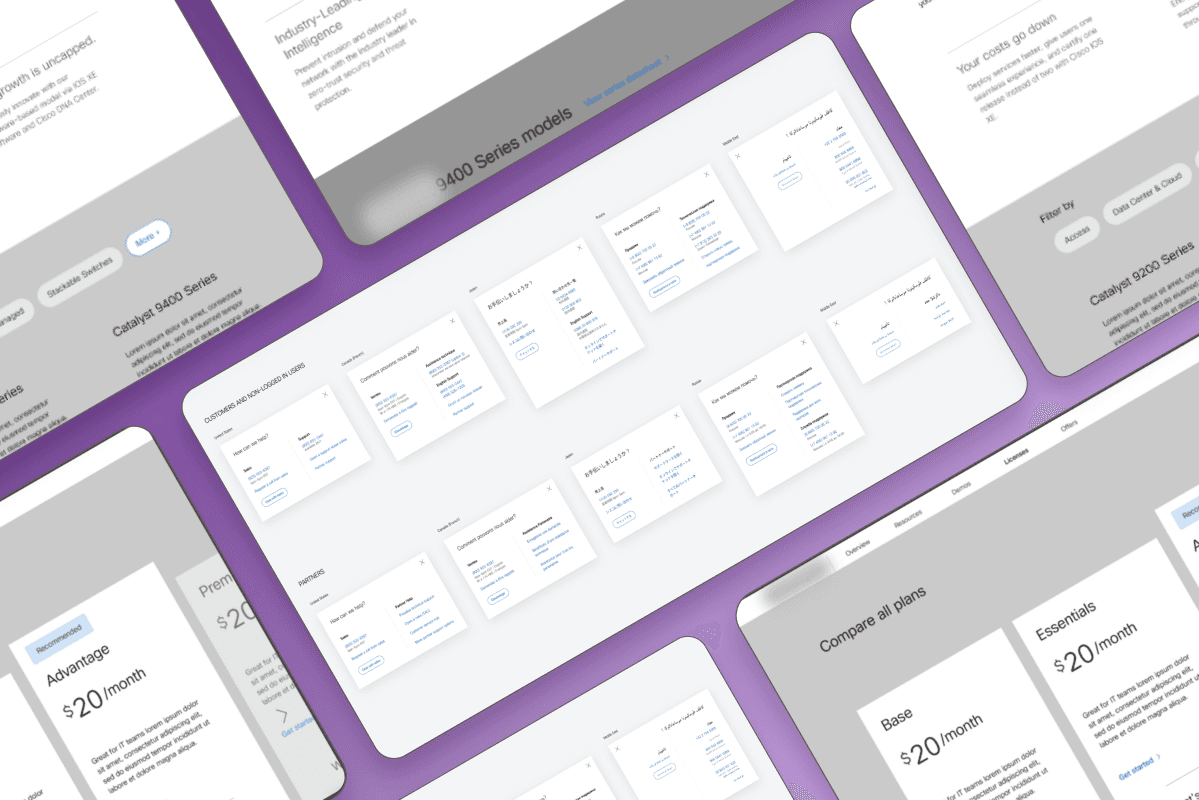
B2B Cloud Commerce Design System: Defining an Experience
A redesign of a design system for a site with over a 1,000 products, 4 acquisitioned companies, 62 countries, 25 languages, AA ADA compliance, AEM Cloud.
Read Case Study
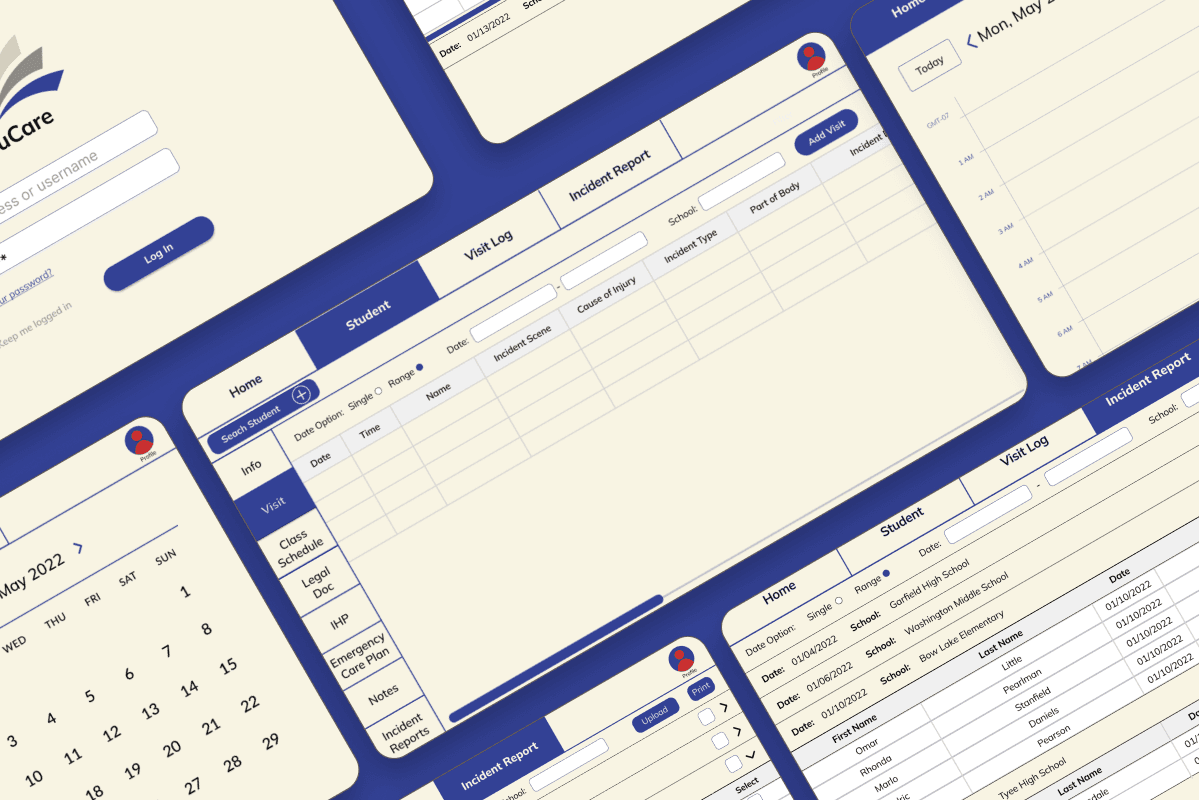
DocuCare: Empowering School Nurses through Better Documentation
A tracking tool born from the vision to not only facilitate but also illuminate the critical work of school nurses.
Read Case Study
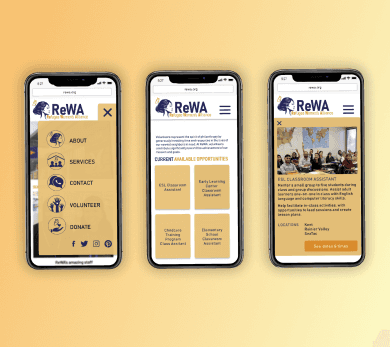
B2B Cloud Commerce Design System: Defining an Experience
A modern, cohesive, and impactful visual identity that authentically reflects the mission of Refugee Women's Alliance—supporting refugee and immigrant women and their families.
Read Case Study
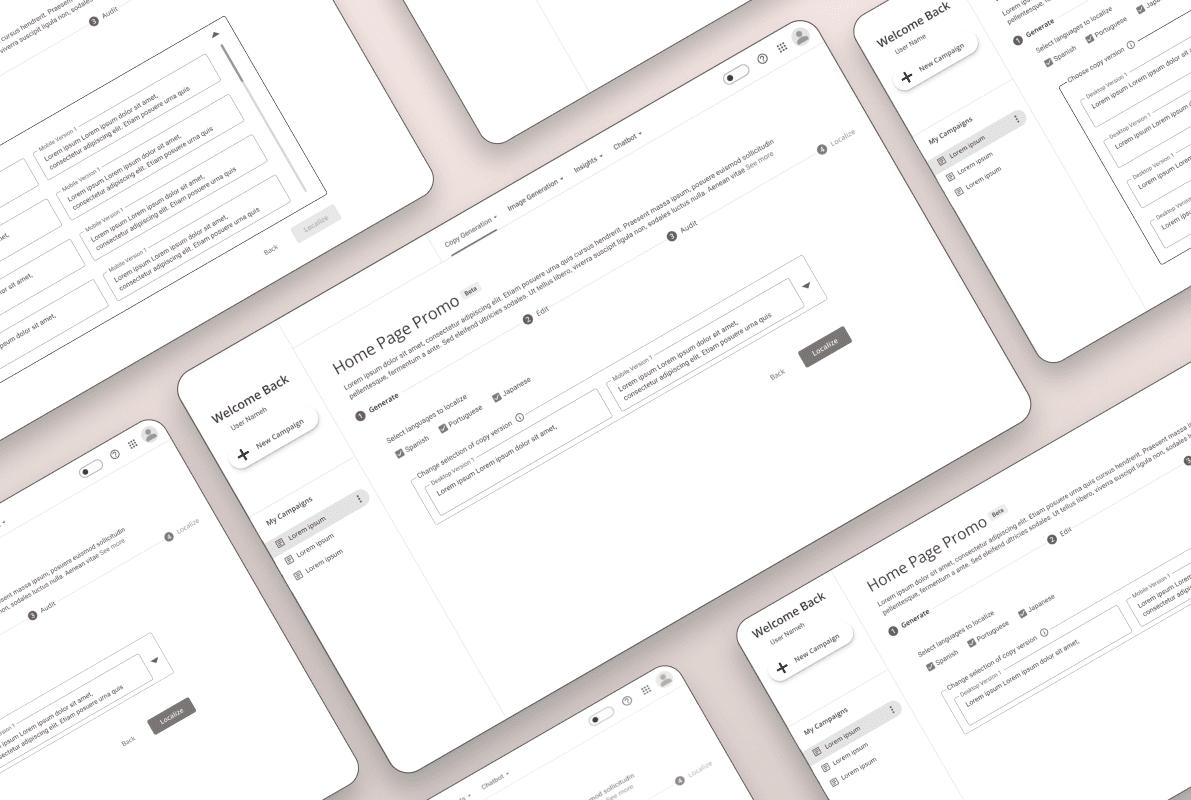
AI-Powered Marketing Platform: Simplifying End-to-End Campaign Creation
A Generative AI-powered marketing platform that redefines how marketers create, refine, and localize campaigns.
Read Case Study
DocuCare: Empowering School Nurses through Better Documentation
A tracking tool born from the vision to not only facilitate but also illuminate the critical work of school nurses.
Read Case Study
Read Case Study
B2B Cloud Commerce Design System: Redesigning a Experience
A redesign of a design system for a site with over a 1,000 products, 4 acquisitioned companies, 62 countries, 25 languages, AA ADA compliance, AEM Cloud.
NEXT
B2B Cloud Commerce Design System: Defining an Experience
A redesign of a design system for a site with over a 1,000 products, 4 acquisitioned companies, 62 countries, 25 languages, AA ADA compliance, AEM Cloud.
Read Case Study
DocuCare: Empowering School Nurses through Better Documentation
A tracking tool born from the vision to not only facilitate but also illuminate the critical work of school nurses.
Read Case Study
B2B Cloud Commerce Design System: Defining an Experience
A modern, cohesive, and impactful visual identity that authentically reflects the mission of Refugee Women's Alliance—supporting refugee and immigrant women and their families.
Read Case Study
AI-Powered Marketing Platform: Simplifying End-to-End Campaign Creation
A Generative AI-powered marketing platform that redefines how marketers create, refine, and localize campaigns.
Read Case Study
DocuCare: Empowering School Nurses through Better Documentation
A tracking tool born from the vision to not only facilitate but also illuminate the critical work of school nurses.
Read Case Study
Read Case Study
B2B Cloud Commerce Design System: Redesigning a Experience
A redesign of a design system for a site with over a 1,000 products, 4 acquisitioned companies, 62 countries, 25 languages, AA ADA compliance, AEM Cloud.